Home Blog Page 79

Student senate unveils new “Wildcat Card”

by Sam Royer ‘15

Within the coming weeks, Student Senate will begin selling “Wildcat Cards,” which will give Ignatius students and faculty the opportunity to shop at local businesses at a discounted price.

The card, designed by senior Karl Fehn, will offer a 10% discount at Heck’s Cafe, Ohio City Burrito, Joy Machines Bike Shop, Campbell’s Sweets, Farkas Pastry Shop, The Souper Market, Koffie, and The Flying Fig. Students will receive a 5% discount at Phoenix Coffee and a $5 breakfast special at Bonbon.

Cards will be available to all students and faculty for $10 and can be used unlimitedly until August 20, 2015. Proceeds from the sale of the cards will go to the senior class and will help defray the cost of prom.

According to Senior Class President Brian Koehler, the idea for the card came up at a senior student senate meeting over the summer. “We all agreed that Ohio City is nicer and safer than ever before, and we wanted to encourage students to go out and experience the neighborhood,” Koehler said.

Over the past month, Koehler, Mr. Evans ‘87, and Danny Ertle ‘15 visited numerous local business owners and convinced nine of them to give discounts to Ignatius students, faculty, and staff. “This card is a great way to explore Ohio City and save money at the same time,” Koehler said.

Although there is no set date yet, the card should be available to purchase in the senior lounge sometime in the next two weeks.

The wisdom next door

by Anthony Ramirez ‘16

If the wisdom of the universe was in the house next door, would you notice? Well, if you haven’t noticed the Jesuit residence, the answer is no. The Jesuits are an unending source of worldly knowledge, and to think they are only a few steps away. Father Ober, a Jesuit and teacher at Saint Ignatius, decided to share some of his wisdom.

Though they may not be as easy to follow as they sound, Fr. Ober’s most important lesson he has learned from his years as a Jesuit is to “find God in all things,” and that patience is a necessary part of life. This also relates to what Fr. Ober believes is the most difficult part of the vocation “living up to the ideals all the time [and] being open minded.”

It is difficult to imagine any man could live up to all the ideals that faith pushes us to pursue, but the Jesuits are expected to be close. What would make a man want to place this much pressure on himself to live a holy life? Possibly the “excellent” pay? For Fr. Ober “the reward of being able to work with people is worth more than money.”

This is enough for many, or at least the Jesuits, to devote their lives to other people, without asking for a worldly reward.

Beside insight in the Jesuit ideologies, Fr. Ober offered two bits of advice to the students of Saint Ignatius. First, “take the spirituality program of the school seriously,” it will help you realize what life is truly about. Secondly, “find one area of study you really enjoy, hopefully even more than one.” Let this be the inspiration for continued study and development in your life.

With this much knowledge and wisdom to offer, the Jesuits are an invaluable resource. Talk to them, and find out how they view the world; it may even change the way you view it. And remember, as the Jesuits do, try to “find God in all things and in all people.”

Bradesca leading the school in creating a college prep environment

by Brendan O’Donnell ‘16

This year, as everyone besides the freshmen has noticed, Saint Ignatius is implementing a number of changes to create a more college-like atmosphere. Among these changes are moving announcements from over the P.A. to a daily email, removing of the bells that start class, and adding several televisions around campus.

These changes have come in the third year of Principal Bradesca’s tenure and are the latest items on the list of other major changes that he has made, including the BYOT policy and the ban on cell phones during school hours.

One major change is the movement of announcements from the P.A. to the email. “We got feedback from teachers that a good portion of students do not listen to the anpart of the announcements. We decided to move the announcements to the email because it is a more permanent way to access the information. We figured that now was a perfect time to do this because of the new BYOT program.”

The announcements are now handled by the Dean of Student Life, Tim Evans ‘87. The content of the announcements, in general, has not changed, and club announcements still take up the majority of announcements. There are no longer “dynamic” announcements, such as announcing an improperly parked car, included in the main block of daily announcements. (These may still be broadcast over the P.A.) The removal of announcements also changed the schedule of classes, removing the homeroom period and moving the end of school to 2:50 from 2:55.

Another new change is that there is no longer a bell to start classes, except for first period and after the examen at the start of eighth period. However, the bell to end classes remains. According to Mr. Bradesca, this was done as a compromise with the teachers. “The original intent was to remove all the bells completely,” he said. “There was a compromise with some teachers who wished to keep both of the bells.” He also said that the change was “experimental” and therefore subject to change.

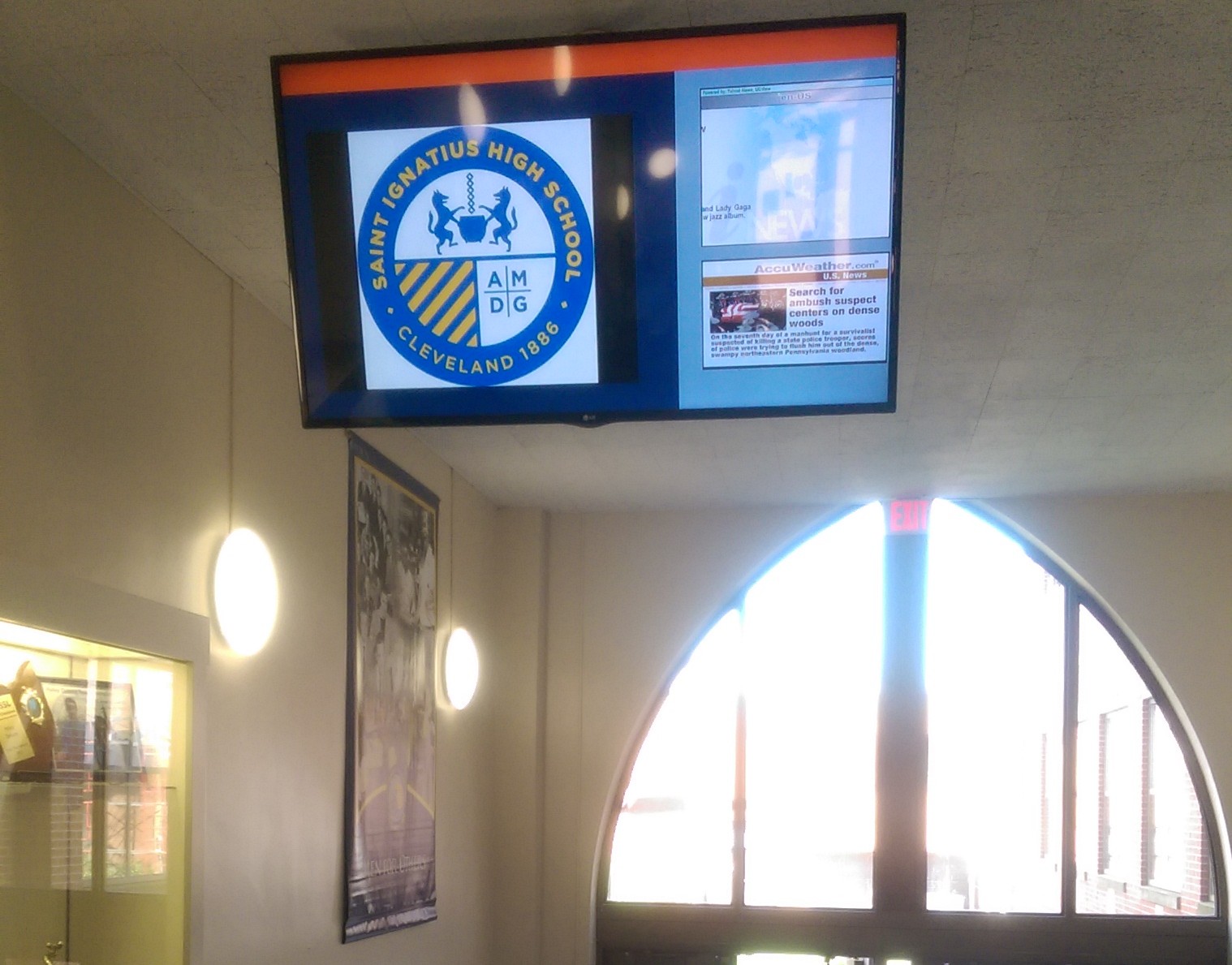
A third new change is the addition of several televisions across campus. Currently, these TVs only show news and weather, and many of them have had technical problems. According to Mr. Bradesca, however, the televisions will have more information related to the school.

“Right now, the TVs around campus are not doing what we want them to do,” he said. “Eventually, they will have scrolling announcements, student life events, and athletic news.”

The televisions will be another way to show announcements and their ability display immediate updates means that they can be used to show important events from around the school and worldwide news.

These are the most notable changes that the school has made to increase the college readiness aspect of the school. Currently, there are no changes in the works, but, as Mr. Bradesca says, there may be more in the future: “College preparation is always something that we are trying to increase. As new research comes out we will adapt to it. If something is proven to benefit students, we will give it a try.”

Ultimately, Principal Bradesca and the staff believe that, as a college preparatory school, St. Ignatius must continue to provide a more college like experience to its students.

“College preparation is one of the main ingredients in our mission,” Bradesca says. “We are not only forming men for the church, but also men for the world.”

Amidst chaotic world, Mr. Skerl brings message of hope.

by John Selby ’15

This is my first issue of The Eye as Editor-in-Chief. I’m very humbled with the honor of this position and am grateful that I have the opportunity to write an editorial in this column.

Instead of writing an introduction about myself, I would like to offer a couple of words about one of the most loved men in the Ignatius community: Mr. Jim Skerl ’74.

With all of the terror and despair occurring in the world with things such as the presence of the extremist terrorist group ISIS in the Middle East, it can be hard to see what can trump these evils. However, hope exists and will always exist.

There’s a famous line in the movie The Shawshank Redemption that goes “Hope is a good thing, maybe the best of things, and no good thing ever dies,” and when I attended the Friday morning mass in order to pray for Mr. Skerl, I felt the very heart of this message.

Looking around and seeing all of those people that one man has impacted in some way was eye-opening, and when Fr. Welsh noted the harsh reality that we might lose this man, it was hard to believe – not because it was just one of those statements that made one’s heart ache, but because if there is one thing Mr. Skerl has shown us all, it is that through prayer and our relationship with Jesus, there is hope.

My first experience with Mr. Skerl was at a CAT meeting sophomore year. I was unsure how CAT worked, but a senior friend encouraged me to attend a meeting. However, I really just went through the motions and honestly didn’t get much out of it. It wasn’t until this year that I realized the effect Mr. Skerl can have on a person.

During the CAT Service Leadership day this year, we went to Fr. Jim O’Donnell’s, a good friend of Mr. Skerl’s, house. I was a little nervous because it was mentioned that we would be washing each other’s feet just as Jesus did with the apostles during the Last Supper.

Well, we did. And though it was uncomfortable to be holding a friend’s foot, it turned out to be a very humbling experience.

At the next CAT meeting, Mr. Skerl could not be present due to a procedure he had to undergo to fight his horrendous cancer.

Mr. Swami, one of the Alumni Volunteers, shared that during the CAT Service Leadership Day he was brought to tears because Mr. Skerl, though weak and probably exhausted, got on the ground and washed his feet.

I decided to go on Labre for the first time after that. Every single person I met during this new experience asked “How’s Jim doing?” It’s a small question, but a profound one. It showed just how much people care about Mr. Skerl.

Although he probably wouldn’t like that I’m writing about him in this form, he’s loved for good reason.

Even if you’ve never met him, you’ve been impacted by him in some way because the love he shows is contagious and the hope he brings is eternal.

“College readiness”: right intentions, but wrong policies

by Zach Fechter ‘15

Last year, I wrote an article for this publication stating that the Wellness Initiative was noble in spirit, but misguided in practice, despite its legality. Frankly, my judgment of the initiative is aptly fitting for the “College Readiness” ploy and subsequent programs that make it up. Acclimating students to a college environment should be a pillar of secondary education, but the manner that Saint Ignatius has chosen to construct this pillar, as well as guide this school year, are feeble, inept, and retroactive, in some cases. In one fell swoop, the school largely stripped from students the opportunity to chose, and from parents the opportunity to parent.

The adopted mantra of the school year includes instituting programs that the administration deems necessary, seemingly without regard for the implementation and consequences of them. BYOT, for example, has been a source of such issues. It’s likely that most, if not all, college students have a personal laptop, same as the new policy requires of us here. However, how often do college students face entire school days without any access to internet connection, thereby impeding on the ability to do school work? Understandably, just as with Haiku last year, when nearly 1,400 students are trying at the same time to access the internet, things can get slow, but that’s what maximizing our connectivity can help with. However, instead of actively strengthening our ability to use our mandated devices, the school has opted to purchase many new large, flat-screen TVs which display small-lettered news stories and the weather to a bustling population of students struggling to get to their next class since there is no longer a second bell; not much time to read that story, huh?

It doesn’t stop there. So the internet is down and a student needs to find out when a club meeting is, what should he do? He can’t check his email on his laptop, he can’t listen to the announcement since, oh yeah, they aren’t read anymore, and he can’t check his phone, as the school has been relatively adamant in enforcing such a rule. Well, sorry kid, looks like you can’t go to the club meeting you want; not very college-like to leave students without a choice.

I will avoid dwelling on the clear dangers of using legality as a point to extract parents from the equation to solve the problem of drug addiction in students. I will steer clear of mentioning that, at the Wellness Program assembly we had last year, it was said that the reasoning behind this program was two tragic events involving alcohol and heroin, yet alcohol will not be tested for, and I can anecdotally assume that heroin is not used at this school, but my formal opinion on the matter can be found in my essay last year.

BYOT policy a possible hindrance to learning

by Jack Seeley ‘16

The implementation of the new and improved BYOT policy this school year seeks to dramatically change the learning experience at Saint Ignatius. Although the school’s good intentions, the policy inadvertently serves to hinder learning at Ignatius; and here’s why:

1. The internet is a DISTRACTION.

Yes, this much we know. But as if it weren’t tempting enough to text, check Twitter, and play games on our phones during class, we now have devices on our desks AT ALL TIMES. But don’t worry, teachers: although we could distract ourselves from how tiresome nine Powerpoint presentations are in a row, we’re just taking notes.

2. Despite the last point, the Internet CAN help. That is, when it works.

One can only imagine how our internet manages itself with over 1400 people connected. And with this mass of students trying to connect (to learn, of course), occasional outages are bound to occur. But when this happens, our dependence on wifi cripples us.

3. Electronics, though helpful, have a battery life.

And when this battery finds itself drained of energy (much like a student), it shuts off, prohibiting any further learning.

And thus is why, much like the last 125 years of Jesuit education, we shouldn’t rely on technologies to progress, we should stick to the good ol’ method of pencil and paper.

3D Printer the latest tech gadget to come to Ignatius

by Brian Sabath ‘17

With every passing year, Saint Ignatius offers its students some of the newest technology to work with, so it was just a matter of time until the school acquired that most sci-fi of modern educational devices: a 3D printer. This year, students in Mr. Jarc’s junior and senior 3D Studio Art class have an excellent opportunity to work with this newsworthy technology that is shaping the field of 3D art.

The MakerBot Port Replicator 5th generation, one of the leading 3D printers in the growing industry,waspurchasedoverthesummer.The juniors and seniors were treated to a pleasant surprise when they found out their class would be using the new technology, which cost only about $3,000, despite its novelty.

The Fine Arts Department aren’t the only ones making good use of the 3D printer: In the science department, Mr. Emancipator is using the machine to combine science and the arts, while Mr. Ward is developing a way to use the technology as means of benefiting the robotics team.

Depending on the complexity of the task, the MakerBot can take anywhere from half an hour to five hours to complete a project, all of which time the mesmerizing toing and froing of the printer’s stylus can captivate an audience. It is therefore fitting that the printer will eventually move to the library. Students can watch the printer in action, to see what imaginative thing an Ignatius student designed.

Our very own 3D printer, the MakerBot, will be of great use throughout the school. Already in use by the Fine Arts Department, and expected to get even more use out of the Science Department. The MakerBot is just another way Ignatius is preparing students for their further studies, and using state-of-the-art technology right in the classroom.

New BYOT and cellphone policies in full swing

by Patrick Millican ‘15

Surveying Rade or the Senior Lounge last year, one could see hundreds of faces mesmerized and illuminated by the glow of their smartphones, then legal on campus. But look out from the same vantage point this year and you’ll see a similar scene–students engaged with technology–but the cellphones have been subrogated by tablets and laptops. The obvious reason for the shift lies in the new BYOT program, but that program’s origins and the accompanying changes in cellphone rules, are not as well-known to students.

While many Ignatians see the BYOT as the brainchild of Principal Bradesca, its progenitor is in fact the Board of Regents, who decided five years ago to investigate and implement a one-to-one BYOT program on Saint Ignatius’s campus. (“One-to-one,” in this context, refers to a program whereby each student possesses his own private piece of technology, as opposed to school property shared by students, as was the case in years past with Mr. Hess’s iPads or the Theology Department’s Chromebooks.) The dual purposes of the program were, first and foremost, to promote digital citizenship and literacy, and, secondarily, to prepare students for college and the constant use of technology there.

First came the research into the Ignatius student body: According to Bradesca, “We discovered that most students already had items of technology at home that they were already familiar with. Why make a student with a laptop go and buy an iPad?” Then, in the course of researching other schools that have implemented programs similar to ours, especially Brebeuf Jesuit in Indianapolis, the Administration came to the conclusion that certain steps needed to be taken to ensure that implementation of the program went smoothly.

For example, each teacher was given an iPad two years ago, in addition to the laptop he or she already had, in order to become acquainted with the relevant software and hardware that students would be utilizing alongside teachers in classrooms. Secondly, over the past five years the bandwidth of the school’s wifi has grown to comply with the eventual stress placed upon it by 1500-odd laptops and tablets.

Since the program officially began in August, Principal Bradesca is proud to report that the reaction from many students and faculty has been overwhelmingly positive. “In fact,” he said, “one student lost his BYOT-enabled iPad on campus, and it was eventually located by using the wifi signal to figure out which router it was accessing and thereby determine where on campus it was.” And, in spite of many fears voiced by students who professed discomfort with leaving their backpacks unattended with their mandatory piece of technology for fear of it being stolen, Principal Bradesca can confidently say that, as of writing, there have been no thefts of BYOT devices thus far this year.

But where does that leave cellphones? Doesn’t the ubiquity of laptops and iPads obviate cellphones? After all, they can perform all the same functions, except calling, which has never been allowed on campus. That kind of thinking is shared by Principal Bradesca, who says that the new cellphone policy is the result of the obsolescence of smartphone technology with the advent of the BYOT. (The new cellphone regulation, in Principal Bradesca’s own words, is that “Smartphones are not permitted for use during the school day,” in case anyone wasn’t entirely certain what it was.) The cause, therefore, was not in fact complaints from too many teachers that students were using their phones in class, but rather that cellphones simply present too much potential for abuse when other avenues of technological interaction are available for classroom use.

But, as with any new policy, from the get-go it hasn’t been universally followed. Still, Principal Bradesca says, “I see students walking across campus with their phones.” He isn’t a proponent of siccing the “cellphone police” (as he terms rigorous and predatory enforcement of the cellphone policy) on students because “that’s not realistic,” and he does plan on allowing an initial grace period. That is not, however, to be taken advantage of or to become an excuse for habitually flouting the rules, since he plans on a gradual ramp-up of enforcement that could eventually include “confiscation and JUGs” if students don’t comport themselves accordingly.

Though it may take some time for compliance to be universal, given how well the school has responded to the BYOT and the cellphone policy, eventually, Principal Bradesca believes, “everyone will get the message.”


New Chinese class puts emphasis on conversation

by Matt Koehler ‘15

As students return to campus after summer vacation, new policies and programs at Saint Ignatius have them talking. Discussions about the new BYOT policy and drug testing program can be heard all over school, but one new there’s one new class that students have given much notice to: the Chinese program.

Over the past few years, interest had been growing within the administration to implement a Mandarin Chinese program here at school.

Thanks to a very generous donation last year from Larry Dolan ‘50, owner of the Cleveland Indians, their plans were able to be realized. The school hired Mrs. Quihui Li, who had taught English at a university in Beijing, China, her home country, and, after moving to America ten years ago, most recently taught Mandarin at Shaker Heights High School.

With the class only open to juniors and seniors as an elective, the course has started slowly. “In order to do it right, we wanted to start at the elective level slowly, to create an interest base, so we could expand the program if it became popular or viable,” said Principal Bradesca. Right now, seventeen students are enrolled in the course, with an average class size of about four or five students, something that Mrs. Li and the students are really taking advantage of, optimizing student-teacher interaction. “The class size is really small, which is really nice,” says Tony Edwards ‘15, a student in the class. “There are only six kids in my class, which is helpful.” Mrs. Li agreed, continuing, “I think we take advantage of the small class. We have much fewer students, so everybody gets a chance to practice during class, many times, so we learn a lot.”

While Mandarin is ver y dif ferent from the Romance languages taught at Ignatius, the class is normal, as students learn basic material such as counting to one hundred, reading a calendar, telling time, etc. However, the language itself is obviously ver y dif ferent from Latin, Spanish, and French, lacking numerous conjugations and having characters instead. “Each language has its own advantage,” says Mrs. Li, “and I think many people think learning Chinese is very difficult, but it is not.” But the class itself isn’t extremely easy, either: “It’s not easy,” says Edwards, “but it’s worthwhile, and Mrs. Li teaches it in a way that you want to work hard.”

While the class is going well so far, at this point, the class will remain open only to juniors and seniors next year, still as an elective only. Along with Mandarin I being offered, juniors who take Chinese this year will be able to take Mandarin II, a course that Mrs. Li is currently creating, next year. “So far it’s going great,” says Principal Bradesca, “and if the course becomes popular enough, freshmen and sophomores might be able to take it as well.”

Varsity golf riding hot streak to the postseason

by Owen Miklos ‘16

After one of the most grueling tryout processes the St. Ignatius golf program has ever seen, the top six golfers to emerge were not only expected to dominate locally, but to contend come mid-October at the Scarlet course at Ohio State.

Led by varsity veterans Kevin Duncan ’15 and Harrison Vonderau ’16, second-year returners Owen Miklos ’16 and Zach Morris ’16, and new varsity members Geoff Allman ’16 and Kyle McCafferty ’16, the team got of f to a respectable star t in the first few weeks of August before really hitting their stride. The team won five tournaments in a row, including a 301 at Tannehauf, a season-best 299 at Windmill Lakes, and a 302 at Brookledge during a six-and-a-half hour round plagued by two rain delays.

The Wildcats were able to show they would be state contenders at the Kiley Cup in early September, when they beat the state-favorites Dublin Jerome by three shots to come in second place behind Cincinnati Archbishop Moeller. The Wildcats’ 628 two-day total was led by Geoff Allman with back-to-back 76’s.

Thus far, the Wildcats have shown that they are capable of going low. With each of the top 5 players averaging under 78, these boys are going to be making a run worth watching for the state title.