Home Blog Page 78

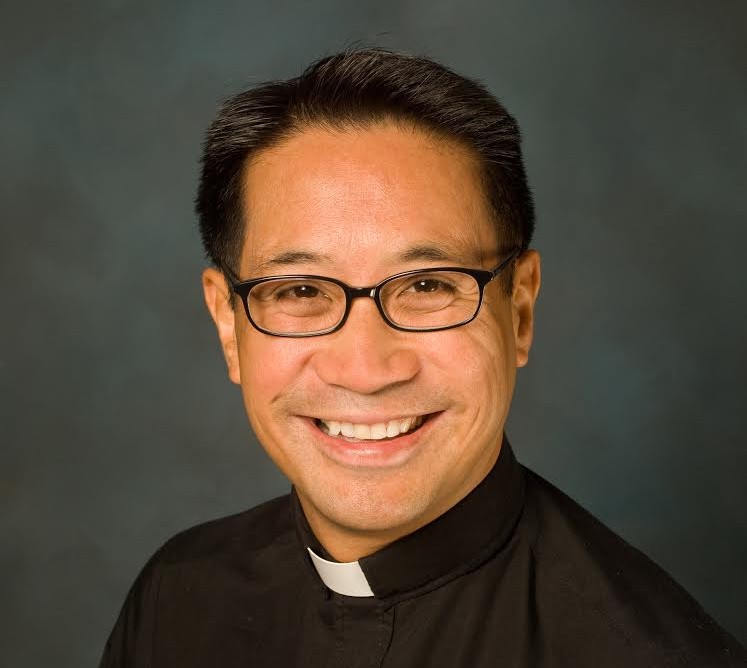
Rev. Ray Guiao, S.J. ’82 named 26th president of Saint Ignatius High School

by Sam Royer ’15 and other Eye Staffers

Saint Ignatius has a new President-elect.

In a letter from Mr. Michael Frantz, chair of the Board of Regents, and Mr. Joe McAuliffe ’80, chair of the Presidential Search Committee, Fr. Ray Guiao, S.J. ’82 was announced as the successor to Fr. Murphy. Fr. Guiao will assume duties of the office on July 1, 2015.

This decision was the culimination of a three-month process that included a call for applicants, meetings with faculty, staff, administrators, alumni, and other key individuals on our campus. Following interviews with applicants and deliberations, the search committee voted to recommend Fr. Guaio. The Board of Regents voted unanimously Tuesday night to approve the committee’s recommendation.

Fr. Guaio’s connection with Saint Ignatius goes back three decades. After graduating in 1982, he came back as an English and Theology teacher from 1992 to 1995 while in the Regency phase of his formation. In 2000 he returned again to teach Theology and direct the school’s vocal music program. As vocal music director, he founded the Cat ‘o Tonics and was the vocal director for the musicals. He also served as Vice President for Mission.

While students may not yet know Fr. Guiao by name, they’re likely already well-versed in his work. Fr. Guiao composed the music and wrote the lyrics for that staple of all-school masses: “Sing We Now to You, O Mary.”

Mr. Kelley ’62, a good friend of Fr. Guiao, called him a “true Ignatian” and “kind and compassionate person.” According to Kelley, Fr. Guiao will bring a lot of experience to his new job including teaching and work in Jesuit formation. “He is proud of his alma mater and excited about returning. He is greatly supportive of students and applauds their achievements,” Kelley said.

“I am deeply honored to be named by the Board of Regents to be the next president of Saint Ignatius High School,” said Fr. Guiao via a press release from the school. “My own vocation to Jesuit priesthood was formed back when I was a student at Saint Ignatius in the early 1980s. Like so many alumni of our school, I feel I owe a lot to Saint Ignatius High School. So, I’m thrilled that I can make some return by serving as the school’s next president.”

This story was updated at 9:01pm 12/18/14.

Student reflects on a pilgrimage to El Salvador and a somber anniversary

by John Killeen ‘16

“What does it mean to be a Jesuit today? To commit oneself under the banner of the cross in the crucial struggle of our time: the struggle for faith and the struggle for justice, which that very faith demands…. We will not work in the promotion of justice without paying the price.”

This quote comes from the Constitution of the Society of Jesus. Ignatius students encounter Jesuits in the classroom every day, but Jesuits are not just teachers. For centuries Jesuits have been involved in crucial struggles for justice around the world. In November I traveled with a parish group to El Salvador, where 25 years ago a group of Jesuits at the University of Central America paid the ultimate price.

El Salvador has long been a place where a small group of elites controls the vast majority of the wealth while the rest if the population suffers in poverty. While the elites have been backed by the military, calls for social justice have been brutally crushed. The small number of wealthy families viewed all attempts by the peasants to unionize, climb out of poverty, or protest against violent repression as “Marxism” and pushed the military to commit atrocities against whole villages of common Salvadorans.

By 1980, tensions between the population and the military reached a breaking point after the military assassinated Archbishop Oscar Romero while he was saying mass. Days later the military opened fire on the massive crowd attending Archbishop Romero’s funeral. A brutal civil war erupted between anti-government guerrillas known as the FMLN and the U.S. backed military dictatorship government.

During the war the military and the Jesuits at UCA had a tense relationship. The Jesuits had spoken out for social change in El Salvador and had called for an end to the war. The military had accused the Jesuits of helping the FMLN by supplying them with guns, and hiding guns at the University. On several occasions, the military had ordered the Jesuits to leave the country, but they refused.

By 1989 the war had been going on for 9 years and both sides were tired of the conflict. In the early part of November 1989, the FMLN began a large offensive in San Salvador, the capital, and gained control of part of the city.

On November 13, 1989 a small military squad came to the University and knocked on the door of the Jesuit residence. The Jesuits welcomed them in and allowed them to search everything. The military didn’t find anything and the Jesuits invited the military to come back the next day to search during the daylight.

The same military squad returned in the early morning hours of November 16. The leader of the military squad knocked on the door and led the Jesuits outside with other soldiers. They were then laid face down in the yard. The soldiers also found two women, a housekeeper and her daughter, who had slept at the Jesuit residence that night in order to get away from the danger of where they lived. The soldiers brutally killed all the Jesuits and the two women. The soldiers attempted to make it look like the Jesuits were killed by FMLN guerrillas, but investigators quickly determined this was the act of the military. The massacre created outrage around the world, and is one of the primary reasons that the U.S. Congress was finally persuaded to stop funding the Salvadoran military. Once the funding stopped, the war came to an end.

Every year people gather at the University to commemorate the men and women who lost their lives. The people that gather at the University each year are gathering to show how much they care about what happened and that they appreciate what the UCA Jesuits had done not only for the University, but for the people of El Salvador.

These Jesuits stayed even after they were threatened. They spoke out for social justice and peace even when they knew the military would target them. They did it because they knew the people needed them.

I attended the 25th anniversary of the UCA massacre. Standing at the very spot it happened, I felt deep in my soul that I had witnessed something so much greater than myself. I experienced something that not very many people get to experience, and I realized that there is way more to life than just what is happening in my little bubble in Cleveland. This experience opened my eyes and allowed me break away from my day-to-day life. I feel incredibly blessed to have been a part of it.

I also received an unexpected bonus. I got to walk the candlelight procession at UCA with Father Kesicki, the former President of Ignatius who is now the President of the Jesuit Conference. I was able to just talk to Father Kesicki about what happened at UCA, and about my experience at Ignatius. Speaking with Father Kesicki made the experience that much more meaningful for me.

I learned a lot from this experience, but what stuck with me the most is that no matter what happens, being a man for others sometimes takes a great deal of courage. We should all admire these men who had the courage of their convictions and were willing to pay the price for justice.

Of tigers, wildcats, and artistic Jesuits: The past and future of the Sullivan Wildcat

by Michael Broerman ‘15

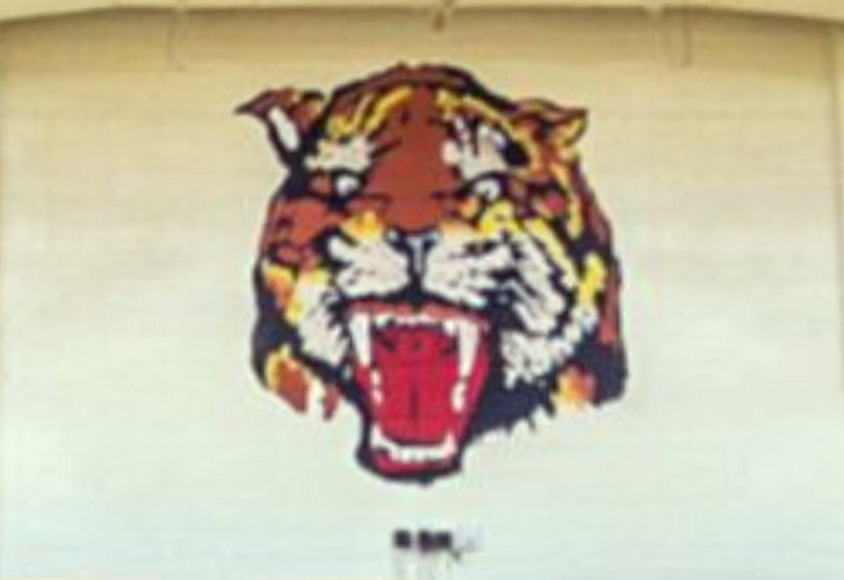
We live amongst many legends here at Saint Ignatius, but none are as tantalizing as the wildcat on the wall of the Sullivan Gym. Something that makes it such an interesting legend is first of all the fact that it is NOT even a wildcat. There has been a Bengal tiger on the wall of Sullivan Gym since the early 1980s and the vast majority of the students at Saint Ignatius do not even know why. According to Mr. Hennessy ‘78, legend has it that “during Father Styles’s term as President, Pater [Styles] painted the ‘wildcat’ on the wall of the gym with students. As you could imagine, Pater was not the best artist so Pater projected the tiger onto the wall, and proceeded to trace over it.” However, all of this is just urban legend, no more reliable than the rumors circulating about an undercover police officer posing as a sophomore.

An interview with the man, the myth, and the legend Father Kenneth “Pater” Styles, S.J.,  revealed that Mr. Hennessy was in fact correct.   “If my memory serves my correctly,” jokes Styles, “when I came back from tertianship in 1979, I was asked to be athletic director. Now that’s a stretch, isn’t it? I explained that I had no skills in that area, but nevertheless the school still wanted me to do it.”

One of the first jobs Styles was tasked with was repainting the decrepit Sullivan Gym. So Styles set out with Tom Pasko, who he had named co-athletic director, to find a team to revamp the Sullivan Gym. “There were maybe three students or so who helped me; that’s the best I can remember. The students worked at school at the end of the day to help pay for tuition.” So Styles now had the task and the team, and the only thing he lacked was a design. “The gym had not been painted in years; it was a shade of rose or dark pink, parts were painted light green to match the tiles. I decided to paint everything a white or cream color. The Poster ‘Cats were the ones who had the poster of the wildcat. Really it is a tiger, but then a tiger could be considered a “wild” cat, and at that point in our history we were not all that concerned about biological precision.”

It would be a little far fetched to believe that our own Father Styles with a team of high schoolers painted a ferocious Bengal on the wall of the gym freehand. “I took a picture of the poster and then put scaffolding on the visitor side of the gym. I hauled an opaque projector to the platform on top of the scaffolding. After the drawing projected to the correct size for the wall, I outlined the drawing in pencil on the wall. After that, we filled in the correct colors using the poster as a model.” So there you have it, folks, the undisputed truth about the Sullivan “wildcat” from the artist himself.

So if this artwork were such a piece of Ignatius history, and the product of the hard work of one of our own Jesuits for over thirty years, why would we take it down not even a year after his departure?

“To set the record straight,” proclaims Principal Bradesca, chatting in his office, “we were talking with Father Styles last year about changing the wildcat even before he announced his departure. The decision was in no way a bon voyage to the ways of old. The gym had been the same for over thirty years and we felt a change would do us good.”

Even Father Styles was surprised by the longevity of the Sullivan “wildcat.”  “Nothing lasts forever,”  says Styles.   “Considering the inaccuracy about the wildcat, it was on the wall a long time.”   In fact, it was commonplace for Benedictine students to say that Sullivan was their house because it had a Bengal on the wall and not a wildcat.

So change is in the air once again at Saint Ignatius, as early as this coming spring, the gym will be redecorated with the school shield painted on the wall, the image selected by the students in a poll run by the Eye. But the change will still honor Father Styles’s legacy of student participation. “The new wall will once again be painted by students, but they will be able to add their own spin on the shield,” reveals Bradesca.

“One of the leading ideas is painting the Cleveland skyline behind the shield, and for every state championship adding a star to the night sky.   It would be impossible to satisfy alums from every era, so we decided to leave it up to this generation.”

New Sullivan Gym painting to be voted on by students

by Sam Royer ‘15

Students are being given the opportunity to decide what will replace the current tiger painting on the home side of Sullivan Gym. According to Principal Bradesca ’88, “the gym is being painted in other areas so we are taking advantage of that to make an update.” Bradesca figured the best way to decide what to put up on the wall was to go straight to the students.

Closed to alumni and faculty, the survey will go out to current students only. “Obviously, we have to be consistent with how we display things – we can’t just put any old thing up there. So what I wanted to do was create a survey for all students to vote on all the different emblems we have,” Bradesca said.

“It could be ‘AMDG,’ it could be the wildcat, it could be the ‘I,’ it could be the school seal, it could be the school crest. All of those will be available for choices,” Bradesca said. “I would probably pick AMDG.”

There’s no set date for when the new painting will go up, but Bradesca admitted his goal was for it to be on the wall by the time students return from winter break.

Go to the link below to vote on the wall. You must be logged in to your student email to vote. The top 2 choices will go in a run-off next week. Voting for the first round ends Friday at 3. Only one vote per student.


After the first round of voting, the shield and Wildcat with I took the top 2 spots. For the runoff, a third option–to keep the current painting–has been added.


UPDATE: The students have voted at the Shield won. Details to come… 

Soccer wins 6th state title

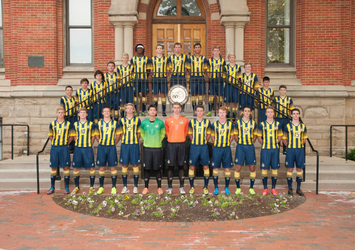
The Saint Ignatius Wildcat soccer team took the D1 OHSAA state final game in a 2-1 victory over Olentangy Liberty Saturday afternoon.

Junior John Duldner scored both the Wildcats’ goals which accounted for half the total goals he scored all season. Olentangy’s Joey Tallarico scored the lone goal for the Patriots with assist by Travis Baum.

A DAY IN THE… Wildcat Marching Band

by Matt Walcutt ‘16

Editors Note: This is the first in a series of ar ticles in which embedded Eye repor ter, Matt Walcutt will experience firsthand various aspects of life on campus.

Ignatius is well-known for our athletics and our academics. And rightly so, our athletes and scholars work hard and are dedicated to what they do. Day in and day out, kids are studying the X’s and O’s of plays while others are solving for x.

But what about the often forgotten about artistic programs the school has? The realm where there’s no numbers other than the musical kind. Some may wonder if they’re experiencing the same hard work as other members of the school.

Let me tell you; they’re crazy at work.

Recently, I immersed myself into one of the great artistic facets of our school – Marching Band. I showed up for one of the practices just to experience a little taste of what it’s like to be in Marching Band. With the exception of playing fantastic bass guitar on Expert in Rock Band 3, I’ve never been a member of anything remotely considered a “band.” Perhaps that made it all the better (and more awkward) when I was actually thrown into a march with the band. I was always a step (or is it march?) behind the man next to me. This clarinet player really knew what was going on. That’s good too, because I was copying his every move. I pretended to hold my “instrument” where he was. I tried to march in-step, tried to mimic the chants, and also tried to act like I knew what I was doing. I think I failed.

Since I’m neither a member of the Saint Ignatius Marching Band nor capable of being within the Saint Ignatius Marching Band, there are some things that I wasn’t able to experience. However, I can imagine the skill that goes into it. I never threw on a marching band uniform or tried marching while actually playing an instrument. Nor did I ever march under the lights of a football field while do- ing all that I’ve previously mentioned. I don’t think I could’ve participated in 10 seconds of Marching Band without messing up horribly.

The Saint Ignatius Marching Band, on the other hand, CAN do all of that. These guys put in hard work and it pays off. As I watched their practice, I could see the precision with which they execute their marches and music. They are true masters of the musical step, but that’s just another day in the arts to them.

On the Cuyahoga or the 50-yard line, Holden Szalek ‘15 is equally at home

by John Dorow ‘15

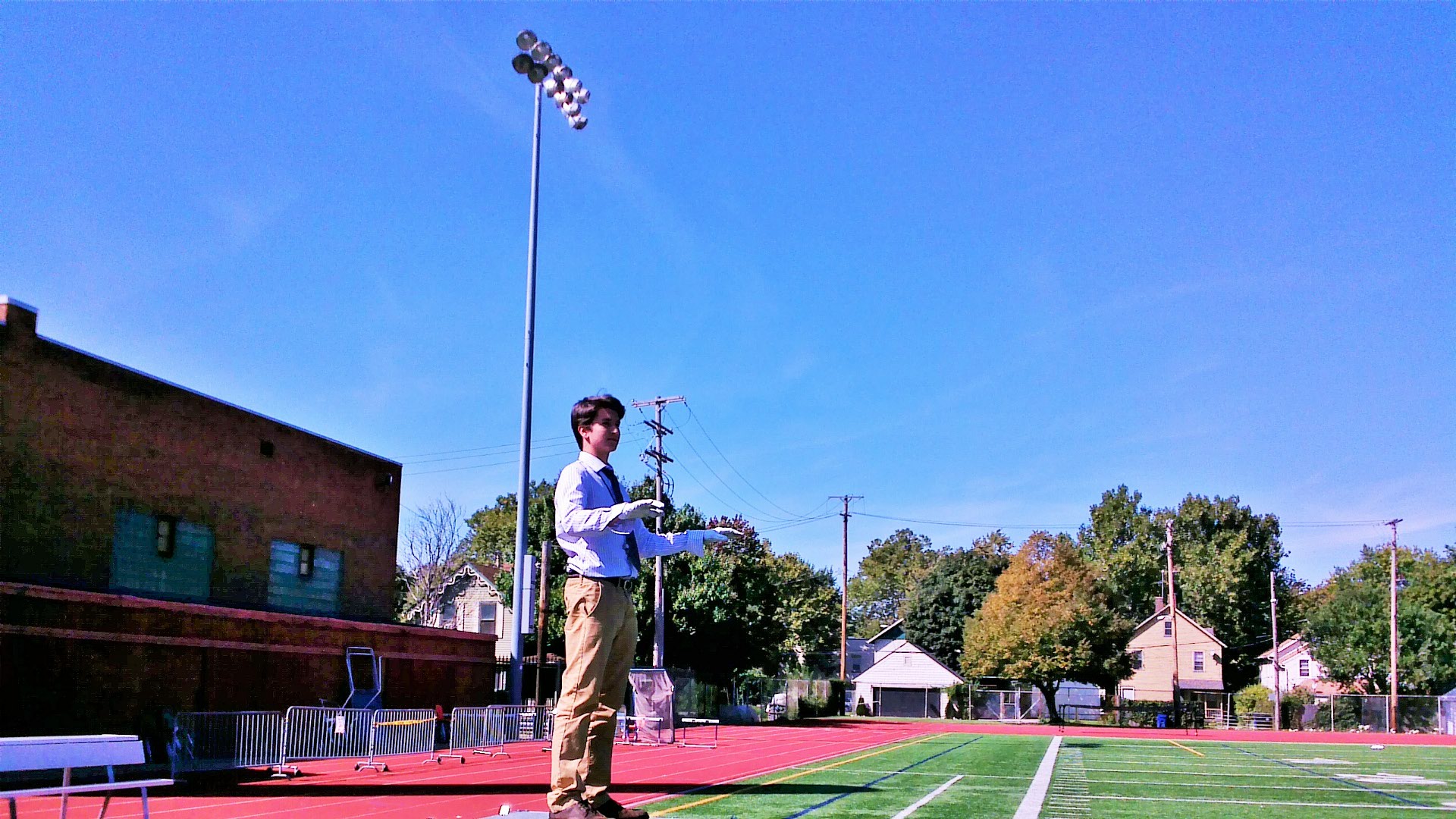
Holden Szalek ’15 represents a crossover of strong talents as a member of the varsity crew team and the senior drum major for the band.

Szalek began rowing crew during his junior year after a few friends encouraged him to join the team. By participating in crew, Holden helped row the team to a silver medal at the Midwest championship last year.

Along with his interests in rowing, Szalek is also an active member of the band. He began performing in the drum line during his freshman year. After an impressive per formance that year, he was promoted to drum line captain for his sophomore and junior years. By senior year he was promoted to drum major. He performs during halftime at the football games on the podium, directing the members of the marching Cats whom he claims, “make my job so meaningful and enjoyable.”

Along with leading the marching band, he has other musical interests. He is a drummer for his own rock band which is working on an album at the moment. The band will also be playing venues such as the High School Rock-off at the House of Blues.

“The amount of time we put into looking and sounding our best is immeasurable. Finishing a powerful song and hearing everyone appreciate with clapping, it is one of the greatest feelings. It’s much like crossing the finish line in a crew race,” he says.

Szalek attributes his multiple successes to his superiors. “Mr. Hamlin and Coach Connor are definitely men dedicated to making their respective activities the best they can be,” he reports.

Holden enjoys both activities and encourages others to try them as well. “Music and sports go hand in hand, and it’d be cool to see more guys attempt to dedicate themselves to learning an instrument and trying something different.”

CONCERT CORNER: A Review of Rise Against’s 2014 Fall Tour

by Brad Horton ’15

The energy was certainly pantomime at the Rise Against concert on September 25, 2014.

The venue was not very crowed when the show started, but that was soon to change.

The two openers, Touche Amore and Rad- key, were typical as openers go, but Touche Amore hard core style certainly puumped up the crowd for Rise Against.

The crowd at Nautcia Pavilion swelled mas- sively when Rise Against came on and its was certainly electric. Near the edge of the stage there was moshing, fist pumping, drunken singing, and a large number of crowd surfers.

Most of the songs played were from Rise Against’s older music with only two songs from the new album, The Black Market. Some of the smash hits played include, Swing Life Away, Prayer of a Refugee, and Make it Stop(September’s Child).

Tim McIlrath, lead vocalist of Rise Against, spoke very little during the show. He did express the importance of the culture od band’s shows, inquiring why it took so long for the people new to show to find the band. However, the minimal talking was accepted by the crowd with apporval of head banging, crowd surfing, and moshing during most of Rise Against’s songs.

The Rise Against concert was a great expe- rience. The crowd was obviously very pas- sionaite about the band and knew how to have a good time. It was opportunity to not only hear Rise Against live, but also get in touch with the Punk lifestyle.

Jim Skerl’s profound legacy of Christian service left a permanent mark

by Sam Royer ’15 and Patrick Millican ’15

“Love one another…Go learn something.” These two maxims are the foundation of Jesuit education, and their speaker, Jim Skerl ’74, chose to make them his last words to the Saint Ignatius community on October 3, 2014, his final day as a teacher. A committed disciple of Christ, Skerl, who passed away at the age of 58 on Thursday, October 23, 2014 after a 20-month battle with pancreatic cancer, will not quickly fade from the hearts of those blessed to have called him a neighbor, relative, colleague, teacher, and friend. The indelible mark imprinted by Jim Skerl on the character of service and love at Saint Ignatius has left many who have encountered him to come to grips with the impact he has had on them and the school.

After four years away from Ignatius spent at John Carroll University, Skerl returned to his alma mater in 1978 to teach theology for the first of thirty-six years. It wasn’t long before the novice became a veteran who commanded respect. Indeed his charisma was such that three current theology teachers Dan Galla, Dan Baron, and Marty Dybicz immediately recognized his Christlike approach to life.

“I was teaching freshmen and some guys had really gotten out of line. They did something seriously bad in class and I had four or five of them that I held in the hall for a lecture,” said Deacon Galla. “I’m really giving it to them, and this is like two to three weeks into school at the most. After I let them go, Jim took me gently by the elbow and said, ‘we don’t do it that way here.’ I never forgot those words.”

Baron’s connection goes even further back. “I first met Jim in high school. He was a year younger than me. I went to [Cathedral] Latin, so we were rival schools, but a lot of my friends knew him. At Latin, we hated the kids from Ignatius. But not so much Jim Skerl–he was just a good guy,” Baron said.
[pullquote]

We decided that those are the things we’ll say yes to – the things that call our kids to ‘feed the hungry,’ ‘visit the sick’ and ‘clothe the naked,’”

– Dan Baron[/pullquote]

But perhaps the story that best illustrates Skerl’s innate appeal comes from Marty Dybicz. “I was visiting my fiancée’s family in Cleveland when we stopped at what’s now the BP gas station in University Heights. Back then, gas stations used to have employees who would fill your gas tank for you and clean off your windshield. The first time I ever saw Jim Skerl, he was cleaning the car window with a big grin on his face. My first reaction was ‘what does that guy have to be so happy about?’ That was my first thought of Jim Skerl. I can still picture it,” said Dybicz.

Once at Ignatius, Skerl wasted no time taking the initiative to ensure the “Men for Others” motto, which had recently been adopted then, would be put into practice. For a while, Ignatius’ main extracurricular program was called the Student Community Involvement Program (SCIP). While the program was ostensibly devoted to helping students grow in their faith through community outreach, students in SCIP were often tasked with service jobs that didn’t challenge them spiritually. Dan Baron recalls a time when the school received a request from a foundation looking for student valets for an upcoming charity benefit. “The cause was good, but it was far removed from direct service. Mr. Skerl was all about the works of mercy. We decided that those are the things we’ll say yes to – the things that call our kids to ‘feed the hungry,’ ‘visit the sick’ and ‘clothe the naked,’” Baron recounted.

This commitment was realized when Skerl created the Christian Action Team (CAT), an umbrella organization that covered all extracurricular student service opportunities. “CAT evolved out of the desire to bring all these different service activities under one umbrella. Those were Mr. Skerl’s efforts. He was the driving force. We had all these really good things happening but they were happening independently of each other. He brought them together under the umbrella that we call CAT,” Baron recalled. “He was instrumental in making sure that all of our service efforts were prayerful and Christ-centered.”

To the preexisting service opportunities, Skerl added Labre Homeless Ministry, the Arimathea Pallbearer Ministry, and the L’Arche chapter. And that goes without mentioning the litany of service organizations the development of which Skerl spurred on and guided.

This commitment to the works of mercy resonated with the student body. As a testament to this, Baron recalls at the first Potter’s Field Pallbearers Mass, where there were a total of eleven people, including himself and Skerl. “Now we get close to two hundred people. And that’s because of Skerl,” Baron said.

Danny Ertle ’15 is the first to say that his participation in service was heavily influenced by Skerl. “Mr. Skerl literally took his faith in Christ to the streets. His commitment to service was simply contagious and will forever change my life. He was a living example of what Christian men are called to be,” Ertle said.

Skerl’s contributions to service at Ignatius are even now challenging teachers to get more involved themselves. “I tried keeping up with him during this school year, but I couldn’t keep pace with all that he does. And he was sick! We kept saying, ‘Who’s going to replace him with Pallbearers, with CAT?’ and it’s going to be six people. I’m not kidding! Because he did that much,” Baron said. “He missed two days of school since he’s been sick. One of them was the day he had surgery, and he came in that evening for ‘Meet the Parents.’”

Committed to living out Christ’s example, Skerl couldn’t help but put others first even in his last hour. “He was home, and we were down to the last days. He’s lying on a hospital bed and decided to pray for all of the people who had used his bed before. Who thinks about that? Who thinks about praying for others who have gone before them, who have used this bed before them?” Baron said.
[pullquote]

Who thinks about that? Who thinks about praying for others who have gone before them, who have used this bed before them?”

– Dan Baron[/pullquote]

Jim Skerl’s legacy will be one that many will struggle to replicate for years to come. The epitome of a man for others, he has been an example to all by ensuring that regardless of background, Ignatians can find common cause in the works of mercy. That shared focus, according to Dybicz, is Skerl’s greatest impact. “I don’t want to downplay all the efforts to be men for others before Mr. Skerl, but Mr. Skerl clearly took the school’s efforts to be men for others a quantum leap above what it had been. He did it the very best way – by basing it not on politics, but on the works of mercy. Kids who identify themselves as liberals, and kids who identify them as libertarians, and kids who identify themselves as conservatives, have all been involved in CAT. The emphasis on CAT was looking at other people as persons, and not as part of some political agenda. And that was a part of the genius of Mr. Skerl. He kept service unpoliticized. He kept it Christian, he kept it Catholic. And that’s part of his legacy that I hope lives forever,” Dybicz said. Here’s hoping.

Thanks Mr. Skerl. Rest in peace.

Updated 8:15 AM October 25, 2014

What You Do Matters: An alumnus reflects on Jim Skerl ’74

Brett Gigliotti ’06 sent this letter to the Saint Ignatius faculty on the day of Jim Skerl’s passing. With his permission, we repost it in The Eye.

With the passing of our friend, Jim Skerl, I wanted to reflect on my time spent and lessons learned over the 10 year friendship I had with him. It was a cold fall day in Cleveland, as I walked down the stairs of Loyola Hall on Sunday night for my first Labre experience. I was a nervous, standoffish, gangly sophomore and my entire understanding and outlook on life was about to change. “Hi friend, would you mind grabbing that cooler and following me?” Jim said. So I grabbed the cooler and followed him into the kitchen. We stood there with other students, parents, and teachers making food for our friends on the streets of Cleveland. That night as we loaded up into vans, and talked with our homeless friends, I watched Jim truly be the hands, feet, and eyes of Christ – he changed my life. From that Sunday on, I was a Disciple of Jim Skerl’s. I never missed another Labre until I left for college. I would like to think that it had a lot to do with being a man for others, but the more I reflect – I was simply following a true man for others.

Our relationship continued to grow. I was now an upperclassman and able to elect the classes I would take in Theology. Death and Resurrection, taught by Jim Skerl – it is a no brainer for me. He walked into the classroom and introduced himself personally to every student in the class. He simply introduced himself as Jim and made small talk with each and every student; that was the first class – all forty minutes of it. Of everything he thought me during that class, nothing stood out more than that simple act. When you are a leader, you take the time to get to know your people on a personal level and show them that you care. Having a teacher in high school introduce himself as “Jim” always made him Mr. Skerl to us. He taught us to get respect you have to give respect.

Fast forward to the end of my senior year; we are attached at the hip. Many of my free periods were spent spending time with him, sitting in the theology office working on this and that. He would challenge me to think differently about life and the way that I would live it. As I walked off the stage at graduation the first person that congratulated me was my friend Jim. He told me that he was proud of me and would miss me in the coming year. And I knew that I would miss him. He always made it a point for me to understand the “what and why” behind our actions. Watching him over the last 10 years he has made the what and why clear as ever for me. What he does: lead by example. The reason he does it: because he cares. What a lesson to learn at such a young age for me.

The last time that I spent time with Jim was about 5 or 6 months ago. Like we always did, we sat in the Theology office and enjoyed each other’s company. He would ask me about my family, life, and career. And he shared about Kym, his family, and all the changes around St. Ignatius. When I told him I was getting married next May, the reaction was similar to that of my own father. A big smile, accompanied with a hug. He also shared some insight into married life, being the long time bachelor that he used to be. He always made our interactions about me, never about him.

Jim taught me more about being a man for others than just about anyone. Jim wrote on my college recommendation letter, “If you want to truly get to know someone, see how he spends his free time.” Jim couldn’t have been more right. This is how Jim spent his time: with his family and friends, with the students of St. Ignatius, with his colleagues, with the homeless men and women of Cleveland, and with the L’Arche community. He spent his time giving, giving, and more giving. Now it is time for us to give back to him and continue all of the great work that he has done.

On 3/28/05 at 11:05AM, Fr. Robert Dietrich sent an email to the entire St. Ignatius High School community. The reason I know this is because I still have the email that Jim printed off for me 9 years ago. It simply reads: “I’m off to God. Pray for me. I’ll pray for you. Peace, Bob.” Fr. Dietrich passed away shortly after. Jim shared this email as an example of how to deal with death. Today, he redefined what it means to have unrelenting faith and spirit in the promise of eternal life.

The reason I share these thoughts and memories isn’t to show you the man that Jim Skerl was – we all know that. The purpose was to show the impact that all of you can have on our students. My life would be very different if it weren’t for Jim Skerl. He taught me what it meant to grow in my faith, understand the bigger picture, and love one another. What you do in the classroom, how you challenge our students, and the way that you make them feel – is the difference between St. Ignatius High School and everywhere else.

“People won’t necessarily remember what you did, but they will remember how you made them feel while you did it.”

AMDG,

Brett

Brett A. Gigliotti ’06
Disciple of Jim
AMDG