Home Blog Page 86

Fastest athlete at Ignatius: Jared Stepka ‘16

by Patrick Millican ‘15

The fastest athlete at Ignatius does not inhabit the football field, nor does he blur by spectators during the hundred-meter dash. His uniform is bulky, intended to shoulder the blows of burly defensemen, but when he is sprinting, he flies.

If an objective, radar-gun toting spectator were to consider the full range of sports at Saint Ignatius, they would inevitably realize that in fact it’s a player on the varsity hockey team that holds the title School’s Fastest Athlete. And the consensus amongst hockey players and coaches is that number 9, Jared Stepka ‘16, claims the throne.

Stepka says that he’s always been rather fast, and it became apparent to him when he was younger that size wasn’t going to be his advantage.

“I realized that I wasn’t going to be the biggest or strongest player, so I had to use my speed as an advantage and keep working on it,” he says.

He cites his strong inner drive as a factor in convincing him to concentrate on his speed. “When I was younger I always had to win every sprint whether it was skating or running,” Stepka said.

Furthermore, Stepka’s quickness affects both his style of play and the way the team uses him to make plays.

“Instead of trying to beat guys by going through them,” he says, “I try to go around them and get into open ice where I have a better chance of beating them to the puck.”

Coach Pat O’Rourke says that the team tries to feed Stepka the puck for breakaways and plays him on power plays to generate an odd-man rush.

His teammates are well aware of just how fast Stepka is. According to Kevin Yarcusko ‘16, “Every time he touches the puck, he’s gone in a flash.”

College Experience Club to organize college campus tours

by Samuel Royer ‘15

The stressful college application process can get a little worrisome for high school students. Starting this spring, the College Experience Club, will give Saint Ignatius students the opportunity to visit college campuses with each other through our College Counseling Department.

According to Mrs. Gabor, the College Counseling director, the College Experience Club’s main purpose is simply to provide Saint Ignatius students with a way to visit college campuses. Gabor, who is also the club’s main contact, said the club should particularly benefit students who wouldn’t be able to go on many college visits otherwise.

Although it will be run by College Counseling, it was sophomore Anthony Ramirez ‘16 who suggested the club be created. “I’ve always thought education is an important factor for success. I haven’t seen another school with a club that allows students to explore their opportunities for college in this way,” Ramirez said.

Wishing to establish a club that would allow students to travel to college campuses in a group, Ramirez approached Mr. Hennessey and Mrs. Gabor. It wasn’t long before planning for the College Experience Club was underway.

The outings, which are planned to occur on school days, would be to various colleges throughout the country. The trips would be free for interested students, with the colleges providing busing and a free lunch.

The club could benefit students unsure of what college options to explore and ease stress surrounding the whole college-decision process. “There’s nothing that beats being on a college campus. I think it’s the single most determining factor for a student in choosing a college,” explained Mrs. Gabor. “Even if he doesn’t like the campus, at least then he’s got some idea of what he does like.”

The club is expected to be operational this spring with a trip to visit Wheeling Jesuit
in West Virginia. Besides that, the club would like to visit another college before the school year ends or possibly in the summer.

Eye survey: too much work, too little sleep

by Anthony Ramirez ’16

Surprise, surprise: Based on an anonymous poll surveying over 160 randomly selected Saint Ignatius students, it was discovered that most students do not get the doctor-recommended eight to nine hours of sleep a night.

Although respondees greatly varied in the number of honors and AP classes each took, the results for students of all workloads were similar.

During an average school week at Saint Ignatius, about sixty percent of students surveyed receive less than six hours of sleep each day. Generally, most students attempt to make up for their lost hours on the weekends, with nearly fifty percent of the students surveyed sleeping more than nine hours each Saturday and Sunday. A shift was shown during finals and midterms, however, with the percent of students that get less than six hours of sleep slightly decreasing to fifty percent.

As for the cause of this lack of sleep, an overwhelming seventy-two percent of respondents agreed that homework is a key factor in how much sleep they are able to get. Sixty-seven percent of students felt that if they had less homework they would be able to get more sleep, but only fifty-four percent of students said that the amount of sleep they receive actually affects their academic performance.With that said, about sixty percent of students also play sports or keep a mobile device near them while they sleep, which many agreed also greatly contributed to their lack of sleep.

On what they think could solve this problem, sixty-six percent of students surveyed wanted Saint Ignatius to take action to help stop this issue. Most agreed that the problem could be solved by reducing homework, or by the less popular option: starting the school day later.

While the students were evenly split in their opinions on a later start to the school day, a slight majority of students agreed that they would not want to start the day later if the school day were to be longer.

Bottom line: While it seems the common problem among students is not getting enough sleep each night, it’s not always too much homework that keeps them from getting their eight to nine hours. Sometimes the students themselves, and their devices, are at fault.

On the water or in the studio, Joe Kollin ‘14 is at home

By Bradley Merk ‘14

Joe Kollin ‘14 is the premiere example of a Hybrid for this edition of the Eye. Joe has consistently stood out in the Saint Ignatius community for both his artistic and athletic capabilities. Whether he is out on the Cuyahoga River rowing with crew or drawing with graphite in Studio Art, Joe is building character through his variety of interests.

As a senior, Joe has been a member of the Wildcats Rowing Team team for four years, taking part in both fall and spring crew. “I have recently come to realize the monumental impact of the sport on my own character,” he says. Rowing is a very collaborative sport. “[It] requires that you have faith in the rowers in your boat to perform to the best of their ability.” Joe believes this reliance on others has been a good experience for him. “Crew has taught me the importance of trusting another person and working to not let another team member down.”

Joe has not allowed his rigorous athletic schedule to get in the way of his artistic talents. He has always had a keen interest in drawing and he has even recently begun learning to play the piano and guitar. If he could pinpoint his interest in the arts back in time, he would probably refer to middle school. “Back in 7th and 8th grade I drew comics for the school newspaper, [and] animated some short films.” More recently he has entered some art into the National Art and Writing Competition.

“And of course I use the talents to show off for the girls.”

Regarding the athletic and artistic division at Saint Ignatius, Joe believes, “arts and athletics can be intertwined more here.” He notices how there is more emphasis on athletics. “I do not think that the arts should be superseded,” he explains.

Joe is optimistic about the future. “The link between the two interests has become stronger and that’s refreshing to see,” he says, citing the Poster Cats and the Marching Band as, “great ways to combine arts and athletics at student events and give the arts more recognition.”

“I think that this separation between the two interests can be eliminated.”

Joe hopes his athletic and artistic interests continue to make him a Hybrid as he prepares to leave Saint Ignatius this June.

Mark J. Johnson oversimplified a serious issue

by Andrew Beddow ‘14

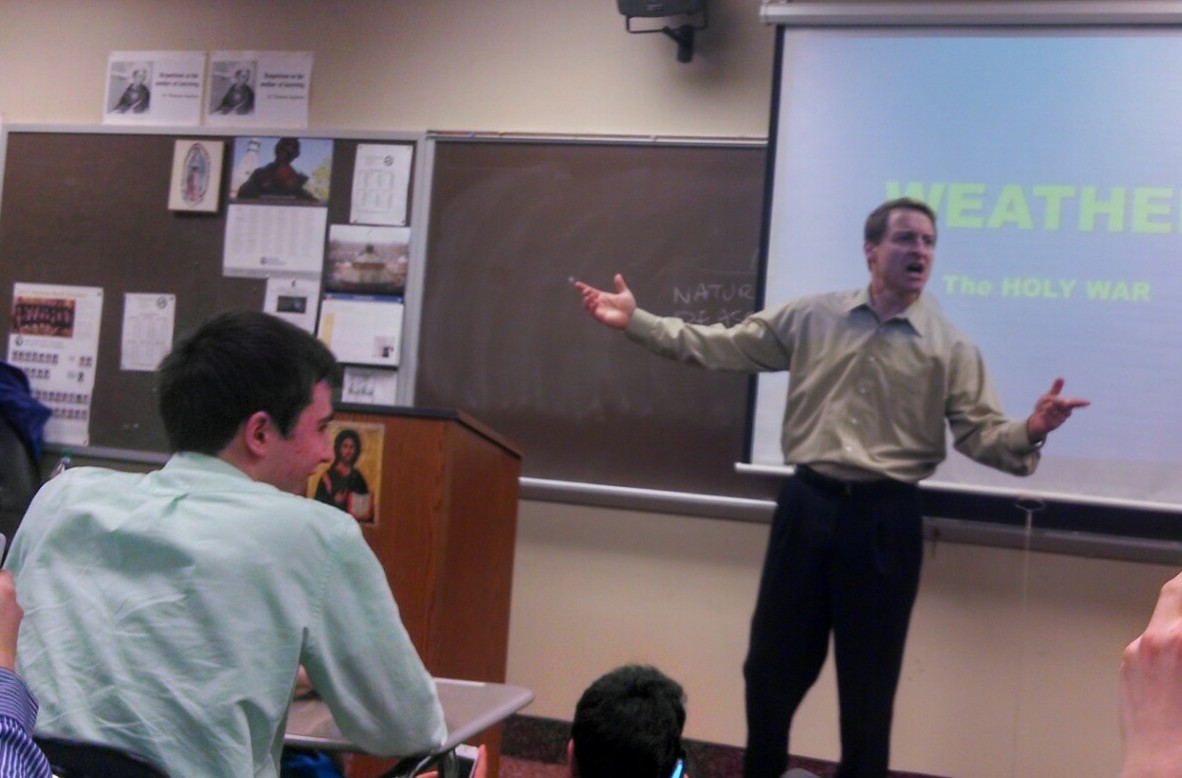
On January 27th, local AMS-certified meteorologist Mark Johnson visited St. Ignatius High School to argue that global warming is neither real nor anthropogenic. Mr. Johnson presented a compelling case for his hypothesis and has, no doubt, dedicated a great amount of his effort to the research of this topic, so I’ll let it be known, my intention is not to refute Mr. Johnson’s essential claim.

I am neither a climatologist nor a meteorologist, so I won’t pretend that I am Mr. Johnson’s intellectual equal in the field of climate change. That said, I do not believe that the skeptic’s case is truly so settled as Mr. Johnson would lead us to believe, and I am concerned that many students may have left the presentation with the erroneous certainty that climate change is a non-issue. Here, I will make the case why global warming remains a real possibility, but why this should not be a public concern regardless.

Mr. Johnson identified two central tenets of climate alarmism – that warming is 1) real/anthropogenic, and that 2) it is catastrophic. Because Mr. Johnson spent almost his entire speech attempting to disprove the first of these tenets, I will begin on this question, though I believe that our concern should lie predominantly with the second of these two contentions. Mr. Johnson raised a number of legitimate objections to the warming hypothesis, but the assumption that these are new objections that have not been taken into account in the existing body of climate research is simply incorrect.

Based on both satellite data and comprehensive surveys of scientific opinion, the scholarly consensus and preponderance of empirical studies seem to substantiate the case for anthropogenic climate change. Analysis of almost twelve-thousand peer-reviewed studies (twenty-nine thousand authors) indicates that 97.1% of climate research abstracts endorse the opinion that warming is real and anthropogenic, compared to .7% to outright reject the consensus hypothesis.

Mr. Johnson’s main objections to the consensus view were that the Earth has not warmed in the last 15 years – though 90% of all warming takes place within the oceans, something that is not accounted for in Mr. Johnson’s US-only graphs – and that urban measurements distort the amount of real warming – though the difference between rural and urban measurements, which NASA normalizes anyway, is relatively small. There exists no evidence that the “Climate-Gate Controversy” in which leaked emails at the University of East Anglia revealed censuring of climate skepticism reflects a widespread conspiracy in climate literature, and the skeptic petition to which Mr. Johnson is a signatory consists predominantly (99.9%) of non-climatologists, and 99.5% of signers have absolutely no formal background in climate research.

Now, there are certainly reasons to be skeptical of apocalyptic depictions of warming popularized in the entertainment industry, and Mr. Johnson is correct in stating that the issue of climate change is an unsettled matter, as many qualified climatologists object to the established consensus view. A number of adaptation strategies, negative feedbacks, climate desensitization , and possible fertilization effects do lend credibility to the belief that, in all likelihood, global warming will not mean the end of the human race – in fact, there will be numerous positive effects of climate change accompanying its predicted negative consequences.

However, Mr. Johnson was dangerously wrong in urging students to discount the consensus view of experts – we do not know the effects of climate change, and Mr. Johnson’s presentation should not serve to confirm students’ beliefs in climate skepticism. This matter is complex and debated within scientific literature – overly simplistic presentations, though not wholly inaccurate, do not truly represent the state of the climate debate, but only serve to mislead the public. We who are not qualified climate scientists would be both intellectually and morally irresponsible to assume ourselves capable of answering this scientific question, so I advise my fellow students to refrain from the pretense of knowledge when it comes to climate change.

Having finals before break just makes sense

by Ben Seeley ’14

Sometimes it’s the case that routine morphs into custom, and self-reflection drifts off into the wind. That’s not to say the routine didn’t serve its purpose or have its day–rather, that we’ve rethought our strategy, opened ourselves to the reality of the situation, and amended the routine to better reflect our condition. So let’s apply that to our winter’s most existential dread: the tragedy of semester exams.

This tragedy poses an optimistic prospect in theory: finals after break is conducive to *more time, more studying, and more A’s*, right? But tragically that’s not the case. So being the honest, pragmatic Ignatians we are, let’s reconsider the merits of the post-break final–namely in terms of real-world time, study, and outcome.

Any high school student can attest to the truth that the myriad free time over winter break is more commonly spent under a pillow than at a desk, and with a hot chocolate–not a pen–in hand. That’s just how it is. Irrational as it is to spend time on trivia and not academia, the still-developing frontal lobes of teens know no better. That’s why we ought to hate the game, not the player. Let’s conform the schedule to the student and not vice versa.

Now onto the very issue of study. As central as the notion of course review is to our pedagogical paradigm, it raises a philosophical predicament of sorts: should the grade received on a final be a testament to devotion to the final, or devotion to the course? Any serious educator would side with the latter, despite what the process becomes in practice. The opportunity for “binge-study” that a pre-final break provides just corrupts otherwise effective instruction.

Ultimately, winter break ends up serving as a counterintuitive crutch for many students and their grades; if two weeks of empty review time lay just before the exam, there isn’t much use in devoting oneself until it counts. In other words education transforms into a matter of ends over means, in which active study and enrichment are foregone for last-minute, transient processing. One student may ace his or her post-break final, but what about the student who already went into break with an A? And lost it on exam day due to using his holiday for its intended purpose to relax?

Such a case shouldn’t have to be a concern.

All in all, the only tangible obstacle to such a scheme is the inequity of the two semesters–that second semester would be a month longer than first. But when you think about it, a lack of symmetry between semesters poses very little threat to the educational system considering the several methods of adjustment.(For example, second semester could end in May and be followed by a monthlong term encouraging reflection or service or independent study.) Time should be a factor of our instruction, not the determinant.

So let’s question the routine. Let’s create a new tradition. And let’s create a holiday break that functions as a holiday should, celebratory of overcome adversity and optimistic for the undiscovered mystery–and not relentless review–ahead in the New Year.

Many countries, many stories: Immigrant families at Ignatius

by John Selby ‘15

There are 196 countries in the world and 1,495 students attending Saint Ignatius. With a ratio like this, it is inevitable that there will be diverse backgrounds on the heritage spectrum that goes farther than the confined corner of Northeast Ohio.

When a student arrives at Ignatius freshman year, one of the first characteristics he learns of his fellow classmates is whether they live on the West Side, East Side, or South Side (or North Side, if you are one of those people.) However, where Ignatius students come from is not simply defined by this common characteristic of one’s location according to the Cuyahoga River. Instead, it is defined by the heritage that shapes the student’s character and contributes to the graduate he becomes at graduation.

Saint Ignatius is one of the most diverse high schools in Ohio with students whose parents or grandparents immigrated to the United States from an array of countries. The following features are just a sample of this diversity.

Yaw Boakye ‘14

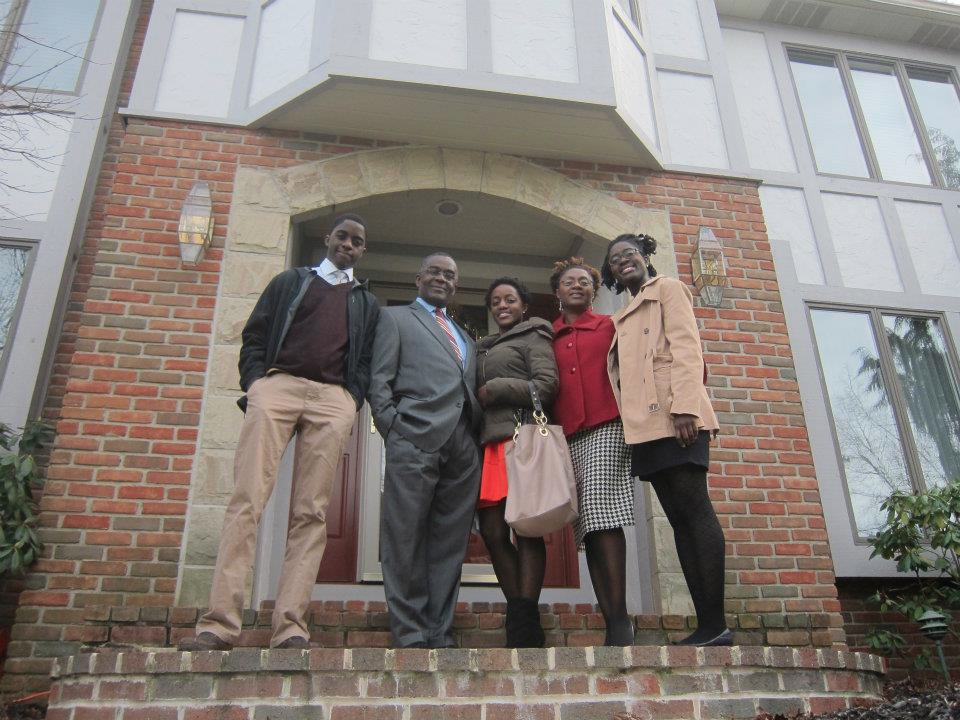
Yaw’s parents both immigrated to the US from Ghana: his mom when she was nine and his dad after he graduated from medical school. They both speak English, but they also speak Twi, which is a Ghanaian language that is most common in southern regions of Ghana.

[pullquote]

“My ethnic background has some beliefs … like the value of education and being engaged in ones community,” said Yaw.

[/pullquote]

“My ethnic background has some beliefs that parents like to pound into their kids’ heads like the value of education and being engaged in ones community,” said Yaw. This philosophy according to Yaw has strong roots in the values and actions of the people of Ghana.

Yaw says that if there are any difficulties that come along with being a member of an immigrant family, he is oblivious to them, citing, “The Ignatius community has always been respectful of my ethnicity.” In addition, the only effect his heritage has had on his life at Ignatius is that many people have asked him about his parents’ origins.

Yaw appreciates having his heritage because it is something that automatically makes him different from what the standard American crowd is used to seeing or meeting, saying, “It’s always nice to have a different name.”

Paul Jakubowski ’14 and Carl Jakubowski ‘15

Although not related in any way, it seems unfair to include one Jakubowski without including the other.

Paul’s parents immigrated to the United States from Poland. His grandmother raised him during his infant years and taught him Polish as his first language while his father was working in construction and his mother as a nurse midwife.

Paul says his family keeps all of the traditional customs during the holidays such as eating Red Borscht on “Wigilia” (traditional Christmas Eve supper) and sharing Oplatki (square looking hosts) before Christmas dinner.

“I frequently visit Poland and keep my strong family values intact with my cousins, uncles, aunts, and grandparents,” said Paul, citing one his favorite aspects of his heritage. Also, Paul says the stigma of being different or worse than others really isn’t too noticeable in his life, saying, “[My heritage] helps me relate to others who are culturally diverse, while also differentiating myself from amongst the student body.”

Carl Jakubowski’s grandparents immigrated to the United States on both sides of his family. On his mom’s side, he is half German, and he is a quarter Polish and a quarter Slovak on his dad’s side but does not speak these languages.

Carl continues Polish holiday traditions as well, eating Oplatki (flatbread wafers) on Christmas Eve and Paczki (jelly donuts) on Fat Tuesday. Carl cites food as one of his favorite aspects of his heritage, saying, “I love pierogies, plus kielbasa is pretty good too from the Polish side. Bratwurst and even sauerkraut are some of my favorites from the German side.” Also, Carl’s grandfather would often listen to polka music, so this has become a special part of his past. Catholicism has also played a huge role in Carl’s life because it is deeply rooted in the countries that make up his heritage.

Carl doesn’t think his life is too different from anyone else citing, “I like to think that if you work hard and have morals, you can get to where you want to go no matter who you are.”

On a final note, Carl states, “I recently saw a movie of my family on my dad’s side in 1955, and that was awesome to be able to witness. Just about everyone drank a lot, including even my great grandmother.”

Keve Pigniczky ’14 and Bende Pigniczky ‘15

The Picniczky brothers’ grandparents emigrated in 1956 after the Hungarian revolution, which according to Keve, failed miserably. They then got involved in Cleveland’s Hungarian community upon their arrival. Keve and Bende are third generation Hungarians, but their ties to their heritage are very strong.

[pullquote]

“I don’t want to lose my unique culture, especially since there are very few Hungarians in the world as there is,” Keve said.

[/pullquote]

They speak, read, and write fluently in Hungarian as well as German because their father minored in German in college and spoke to them in it while they were young. Some Hungarian traditions include: constant use of paprika spice in most foods, famous for pastries, sausages, Chicken paprikas, and Gulyas (Goulash) stew; a rich folk culture, including 300,000 folk songs recorded in history and diverse folk dance varieties; and cultural village traditions such as pig slaughtering, Harvest celebrations, and superstitious beliefs during Easter.

Keve says that he is most proud of being able to speak Hungarian fluently while still being third generation, stating, “I’ve kept myself educated about my culture through Hungarian School, the Hungarian Scouts in Exteris, and the Hungarian Folk Dance Ensemble.”

Keve says that he still faces the adversity of the “melting pot” culture in the United States. “I don’t want to lose my unique culture, especially since there are very few Hungarians in the world as there is,” Keve said. Hungary has lost much of its territory and population to countries such as Czechoslovakia and Yugoslavia, and many Hungarians have immigrated to the US; therefore, Keve says his biggest challenge is keeping and maintaining his culture.

Keve is involved in a folk dance group and Hungarian boy scouts, but says one of the biggest effects of his heritage at Ignatius is his involvement in the Global Outreach Program. Keve will be traveling to Hungary in the spring for four weeks to study at a Jesuit high school Miskolc, making him one of the first students to try a study abroad program during the school year. “I’d be the test-drive for future Hungarians and other ethnicities attending St. Ignatius, and I’m actually really excited for the new experience and hope to learn much from it.”


Art Spotlight: Jacob Alvarado ’15

by Brad Horton ‘15

Jacob Alvarado ‘15 began his art career as a kid who loved to tell stories through drawing. He mostly became interested in art on his own, but had some influence from his friends who also liked to draw when they were kids.

Jacob’s art career began to pick up steam when he enrolled in Ms. Burrows art classes at Saint Ignatius. He revealed his true talent in classes such as Graphic Design and Drawing where he created works such as a typography project of Mcnulty’s Bier Markt. The project involved replacing a photograph with words. Jacob explains, “I have menu’s with me and I choose words from them and put them into each other like a strip of color.” Jacob received a Scholastic Silver Key for his typography project.

Jacob’s interest in the arts led him to becoming involved in the Artists in Residence (AIR); a program for students that excel in artistic abilities. The club allows Jacob to compete in art contests at schools and do commissioned art for neighborhoods.

Jacob states how he has worked on another project to turn into the Scholastic Art Competition. “It’s about a plot I had in my head for a horror game,” he explains,” that [idea] turned into messing with layers and seeing what I could do. And it looks pretty nice, like a poster you would put up.”

In the future, Jacob will take A.P. Studio Art and plans to continue fulfilling his video game concept art for the Scholastic Art Competition.

Jacob hopes to take his artistic interests to a professional level. He has ambitions to become a video game designer, an interest evident in his drawings and previous artwork. “On my own I really like drawing characters I see everywhere on TV that my friends watch or play. I like to hear that I made a pretty good drawing of that guy.”

Students look to the performing arts in college and beyond

by Sam Royer ’15

The path to professional acting success rarely goes without struggle. While many high school students graduate anticipating a practical career as a doctor or a lawyer, there’s a rare few who dare to venture out of the realm of practicality and really pursue their passion.

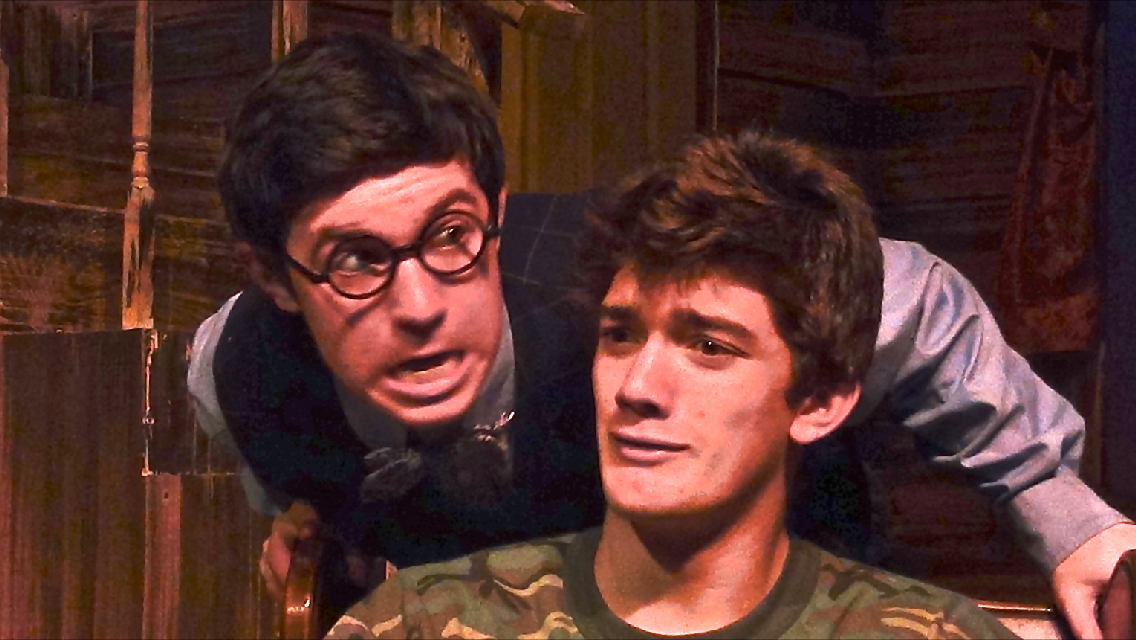
One of those few is John Berner ’14. John first started acting in his sophomore year when he tried out on a whim for Saint Ignatius’s production of one his favorite movies, Twelve Angry Men.

“I didn’t really expect to be cast at all, but for some reason Fuj put me in and I’ve loved it since day one,” Berner said. Since then, Berner has performed in countless other productions and in the process, he developed not only a passion, but a career choice.

Berner knows the road to getting there won’t be easy. “It’s going to be a rough time. But since I started to get involved in it I’ve met many people who have worked hard to make a decent living with theater. It isn’t easy, but it’s certainly possible,” Berner said.

While the risky employment situation is worth it for Berner, some, like David Faust ’15, aren’t able to get past it. Faust, who has been performing since he was in first grade, plans to continue to act in college, but ultimately won’t make a career out of it.

“You know, being an actor is so hard. The problem is, you have to put so much of your time and life into it. For me, that’s not what I want. When you’re an actor, the reality is, if you’re not on top, you’re not making enough money to live. You’re not making enough to sustain yourself or a family,” Faust said.

What the two actors can easily agree on is that Ignatius has outstandingly prepared them for a career in theater.

“We take a very professional approach to our main-stage shows that is a huge contrast to the other schools I’ve performed at,” Berner said. This year, Berner even gets the chance to choose, act, cast, and direct a one-act play.

Faust, who participates regularly in Dramatic Interpretation tournaments, praises the theater staff members who have directed him, including Mr. Thomas, Ms. Stires, and Mr. Fujimoto. Of Fujimoto, Faust said he has learned “the core mechanics of what you must do to make a connection to your character.”

Despite his plans to study Pre-Med or psychology, Faust knows his history with acting has given him a life skill.

“If I go into psychology, I’ll have to be able to relate to people and understand them,” Faust said. It’s also helped him a lot with his public speaking.

Berner, on the contrary, plans to take his skills to Tulane University next fall where he’ll double-major in Theatre and Political Economy.

On choosing to live out his dream, Berner said, “I know it sounds pretentious, but I’d rather live a challenging life doing something I’m passionate about than a basic upper-middle class life doing something about which I couldn’t care less.” Great words to live by.

The Oculus Rift: seeing is believing

by Jake Woomer ‘14

After reaching over $2 million dollars in its Kickstarter, the Oculus Rift has gained popularity on the internet not only by gamers, but by anyone fascinated by virtual reality. To those that do not know about the Oculus Rift, it is a virtual reality headset designed for immersive gaming.

Unlike my past product reviews, when I relied on 3rd party product testing information – I had the opportunity a few weeks ago to test the technology first hand. While visiting Miami University – I was able to tour their Interactive Media Studies Lab where I tested a developer version of the Oculus Rift. I can honestly say that this technology deserves all the positive press it has been receiving.

When I first put on the Oculus Rift I could immediately see myself inside a beautiful house by the sea. Everything about the actual laboratory I was standing in was invisible to me. All I saw was the virtual room. Even though my brain knew I was in the lab – my sense of sight took over and I truly felt like I was in this beautiful home. When handed the controller I was able to move around and explore every nook and cranny of the house. I walked down the stairs and my body felt like I was actually moving downward. I found myself actually having to check my balance. After exiting the house I walked completely around the exterior. I explored the the vast green landscape against a cliff. When I turned and saw the ocean – the view was absolutely breathtaking. Suddenly I felt a tap on my shoulder – it was time for the next person’s turn. And so ended my tranquil experience with the Oculus Rift.

Needless to say my first experience with the Oculus Rift exceeded my expectations – it left me in awe. The visual atmosphere impressed upon me the notions of what this experience could produce. It is without any doubt that this virtual reality technology will play a large part in the advancement of video games, and maybe even our personal lives (Google Glass), in the near future. While the price and launch date have not been announced – you can expect to see the Oculus Rift on the market by late 2014 or early 2015. Look forward to it!