Home Blog Page 82

Calamity days not so calamitous after all

by Benjamin Delhees

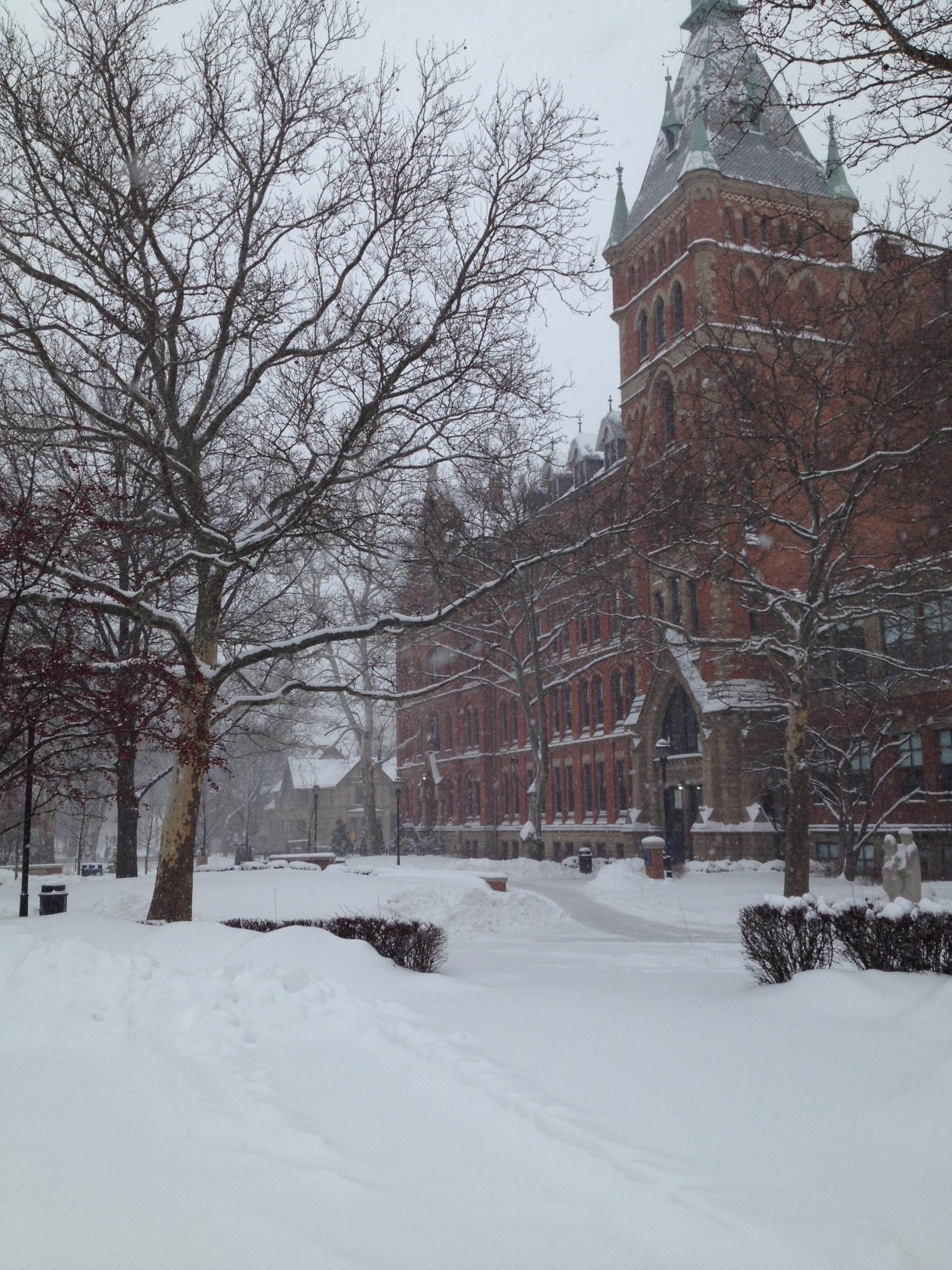
A cold, snowy morning in the middle of January raises the confidence of many high school students in hope of a snow day, a wish that for Saint Ignatius students was granted more often this year than most. But the surfeit of days off raises important questions about the consequences for a the test-saturated student body of a school whose core academic function is to prepare its graduates to enter and succeed in college.

A study done by the Buckeye Association of School Administrators showed that the average number of calamity days during the 2013-14 school year was nine across four hundred different school districts. Saint Ignatius High School scored a total of four, and some teachers believe that their classes have certainly felt the effects of what these days can bring about.

Educators, after all, are the professionals who are forced to adapt their tried-and-true lesson plans to conform to the unusual changes in their schedule. The reality of limited time means that some teachers may have had to cut many different activities such as review days and projects, elements that may be essential to the average student’s learning experience.

However, not all teachers believe that the limited time had deleterious effects on their students.

“Because the presentations and reviews I had to skip were additional pieces of work,” Mr. Bob Corrigan said, his students were not adversely impacted.

Many review days for AP Exams were cut as a result of the abnormally large number of school days lost, according to teachers such as Mr. Corrigan and Mr. Hess. Corrigan nonetheless affirms that the days of were justified, although he pushed his AP European History class’s test date back as part of an aid program instituted by the College Board.

“Student safety is the top priority,” Corrigan said.

The health of the student body is thus paramount in the eyes of at least one stressed college-prep test teacher. But the underlying fact is that calamity days have significantly impacted the way in which teachers have had to educate their students.

Mr. Hess, an AP Economics teacher at St. Ignatius, may speak for many of the school’s Advanced Placement teachers who were forced to contend with unexpectedly close exam dates.
“I wish I had more time,” he said.

Four veteran faculty members bid farewell to SIHS

Matt Koehler ‘15

As another school year winds down, it’s time to give a final thank-you to the retiring teachers who have put a staggering total of 99 years of service at Saint Ignatius: Mrs. Betz, Ms. Lachvayder, Father Styles, and Mr. Surrarrer have all helped students grow and thrive, adding to what the school is today.

All four teachers have put in countless hours teaching students in and out of the classroom: Mrs. Betz, who has taught freshman and senior English for 29 years; Ms. Lachvayder, who has taught chemistry since 2003; Mr. Surrarrer, who has taught chemistry, physics, and biology for 29 years; and Father Styles, who has taught theology, English, and Latin since 1968 and even served as principal in the Eighties–they will all be dearly missed.

Whether they’re leaving Saint Ignatius to retire (or to teach elsewhere, as Fr. Styles will be at Walsh Jesuit High School next fall), these teachers will miss the sense of community and the interaction with Ignatius’s unique faculty and staff. Asked what she would miss most, Mrs. Betz summed up the feelings of the four teachers saying, “I’ll miss the students, the faculty, the staff … This is really more like a family. It’s been a very special group of people.” Ms. Lachvayder will especially miss the joy of seeing the students grow. She loves seeing students “mature in their ability to think analytically and creatively with confidence,” and enjoyed helping them thrive “outside the confines of the classroom and explore the world” in extracurricular activities.

While they’ll miss their days working here, the teachers retiring will definitely enjoy the luxury of time to relax and be with their families. “When you’re a teacher, you have so many pressing responsibilities,” says Ms. Lachvayder, “and you don’t have as much time for leisure and family and friends, and have to give up a lot.” She’s especially looking forward to more time to travel, planning to explore Ireland and visit friends in Montana later in the year. Although she also has plans to travel, Ms. Betz says she’ll still be around, playing the piano at 7:20 Mass whenever she can.

After their hard work, these teachers will certainly miss Ignatius, but also look forward to starting a new chapter in their lives. Ms. Lachvayder put it well: “You know they say take time to smell the flowers? Well, I sure hope to smell a lot of flowers.”

Diplocats excel in debate at Michigan State, Youngstown State

by Brendan O’Donnell ‘16

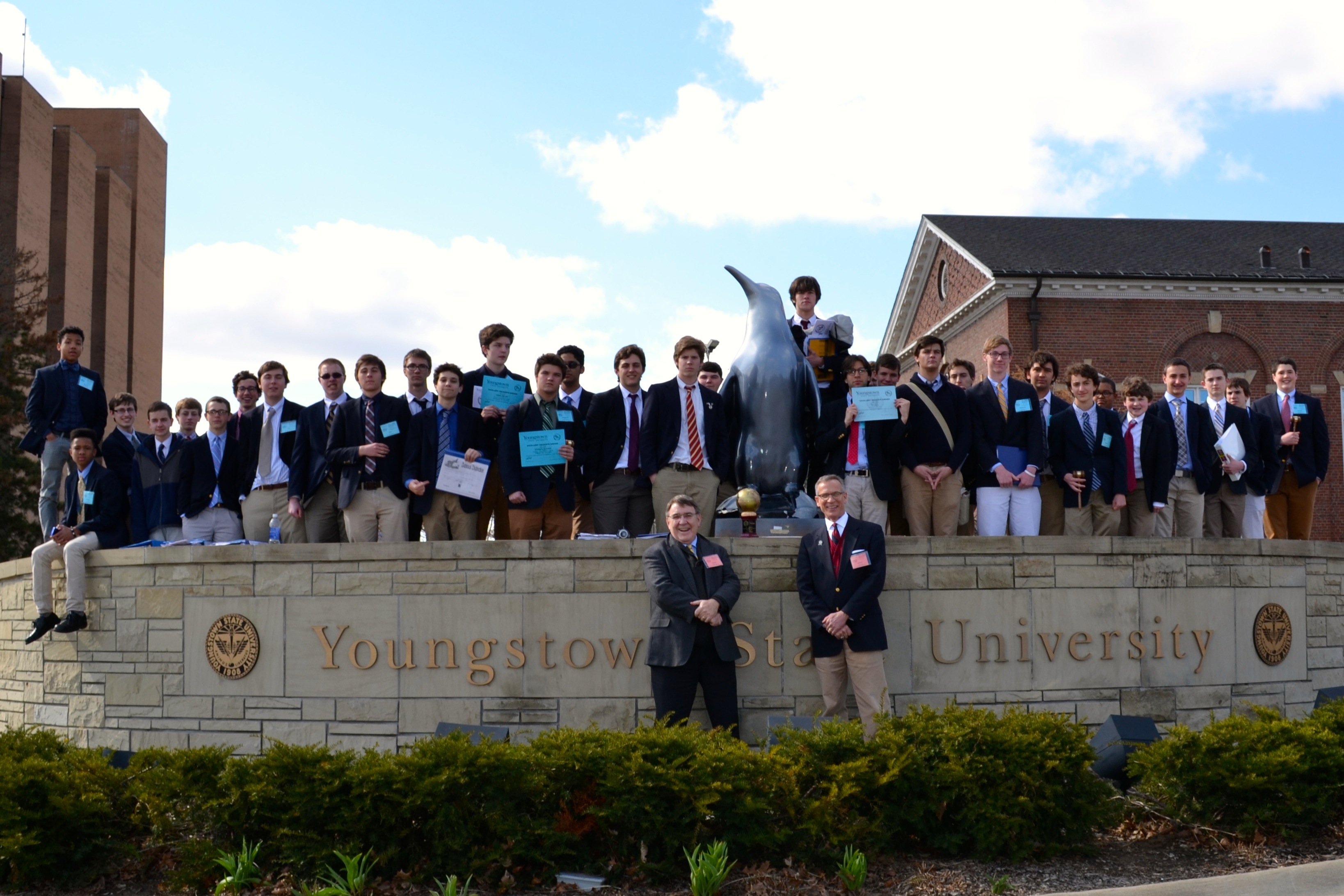
The Saint Ignatius Diplocats – the school’s competitive Model United Nations travel team – concluded a packed but successful season with an overall victory at the mid-sized Youngstown State conference and a second-place finish in the largest category at the nationally renowned Michigan State tournament.

From March 14th to 16th, 39 delegates from St. Ignatius competed with over thirty other schools at Michigan State University. The delegates debated in thirteen distinct committees, discussing solutions to topics ranging from Syrian refugees and drone warfare to a reenactment of the 1787 Constitutional Convention. This was their second conference of the year, following the November conference at the University of Virginia.

Nine students from St. Ignatius won awards. David Pietrow ‘17 and Kellen Dugan ‘15 won verbal accommodations for their performance in committee, while Zach Keirn ’14 and Mark Raddell ’15 earned “book awards” that are akin to fourth place, an impressive honor considering that Model UN committees often incorporate more than fifty delegates from as many schools.

Tyler Delhees was awarded “honorable delegate” (third place) for his work in committee, while Charlie Heintel ’16 and Zach Stepp ’14 received outstanding delegate awards (second place). Andrew Beddow ’14 and Alastair Pearson ’14 teamed up to win the best delegate and gavel awards in their committee, a simulation of a hypothetical international convention to reform the United Nations itself. Overall, St. Ignatius won the award for Outstanding Large Delegation, a second-place finish.

On April 4 and 5, 34 delegates from Ignatius competed with over ten other schools at the Youngstown State University Model United Nations Conference. There, delegates debated a diverse slate of issues such as the crisis in Ukraine and the international legal framework for protecting children’s rights. This was the third and final Model United Nations conference for the Diplocats, and in terms of awards as a percentage of delegates their most successful.

At YSU, nine students earned awards. Freshmen Colin Caniglia (Excellent Award and Chair Gavel) and Owen Hearns; juniors Kellen Dugan (Excellent Award and Chair Gavel), Patrick Millican, Anthony Edwards, and John Selby; and graduating seniors Tom Horan, Zach Stepp, and Ben Seeley all won awards.

The gavel, won by Pearson and Beddow at Michigan State and by Dugan at Youngstown, is the highest honor a delegate can receive in Model United Nations – a statement that the recipient has upheld the highest ideals of the MUN tradition.  Moreover, Saint Ignatius was the overall victor of the Youngstown State tournament, putting them in contention for a ranking in the top fifty high school delegations in the nation, as ranked by www.bestdelegate.com.


Head Delegate and President Kellen Dugan feels that these were the best delegations he has seen in his years of experience.

“They performed above and beyond what I’ve ever really seen. Aside from Gannon [in 2011], we performed better than at any other conference,” he said.

Dugan believes that an increase in enthusiasm was the cause of this success.

“[Delegates] really enjoyed the conference, and they wanted to get involved rather than being dragged along, he said. Dugan believes the awards were the result of the four months’ worth of training put into the conference for MSU, as well as the enthusiasm carried over into YSU from the stellar performance at MSU.

There will be no more conferences this year, but next year the Diplocats will be back.

With excellent performances this year, Saint Ignatius will likely be one of the top delegations in the country. The season of trophies should serve as an incentive for the school’s top academic and debating talent to join the circuit for next year.

The Zupan Presidency: Not every promise kept, but we love him anyway

by Owen Miklos ‘16

MID-YEAR GRADE: A-

FINAL GRADE: A

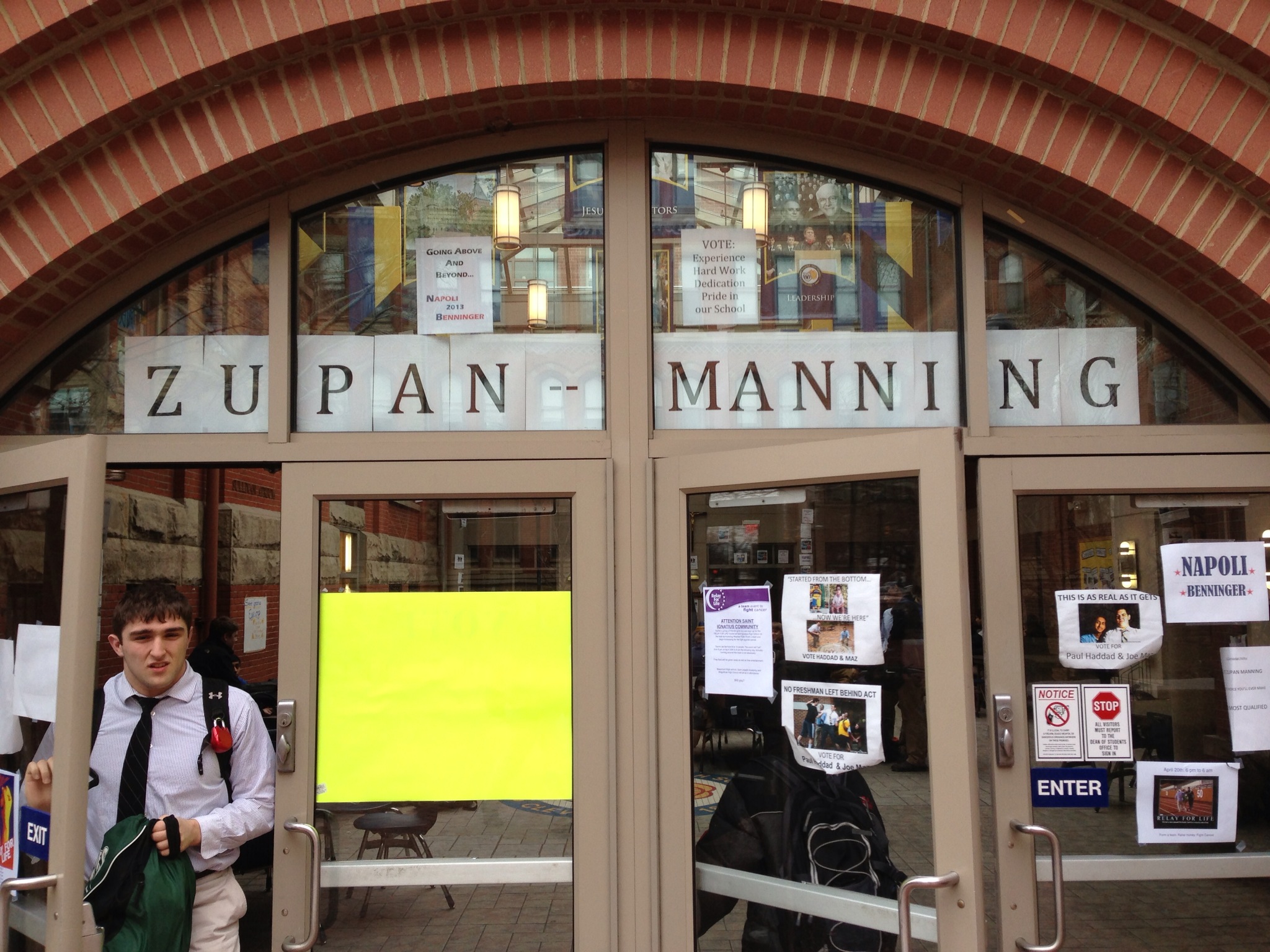
Almost one year ago, current sophomores, juniors, and seniors elected the slate of Michael Zupan and Owen Manning to serve as the Student Senate executive branch for the upcoming year. Along with his running-mate Owen Manning, Zupan preached a policy of involvement, a legislative agenda focusing on increased support at sporting events and dedication to improving on the tried-and-true methods set up by the previous presidents.

Now, fast-forward to now, and “Czar” Zupan is preparing to hand the reins over to his successor, Pat Mulach.

So, how’d he do? The question has two dimensions – public opinion, and his ability to keep his campaign promises.

The majority of the feedback he’s received has been positive, and between the success of Homecoming and the overwhelming crowds present at the playoff basketball and hockey games, the Zupan administration was evidently doing something right. The athletic director and varsity hockey coach Pat O’Rourke credits much of their success to the student section, led by the president himself.

Zupan is also credited for broadening the scope of the 3-on-3 basketball tournament, this year drawing record numbers for players and making it one of the premier extracurricular sporting activities at St. Ignatius.

However, not all of his promises were kept.

From the beginning, there was speculation as to how Zupan would be able to draw crowds to lesser-attended sporting events. It seems that that initiative was abandoned right from the get-go. Certainly, football and basketball and hockey drew record-breaking attendance, but that was where the success ended. Sports like golf, wrestling, bowling, and tennis continued their surge in proficiency in everything except crowd-drawing. Swimming finished fifth in the state with nary a supporter in sight.

When asked if he thought the presence of a larger crowd would’ve made a difference, golfer Andrew Zawie ’16 gave an emphatic yes, recalling his 121-yard hole out mid-season.

“If there was a crowd, I’d probably have body surfed,” Zawie said.

But despite this relatively minor misstep, President Zupan was – and for the remainder of the year, still is – one of the more charismatic leaders this school has had. Like El Presidente last year, Zupan won over the student body early on, and this effect has never worn off.

A look back at curriculum changes this year

Michael Sweet ‘17

Saint Ignatius High School welcomed a full slate of new courses for the 2013-14 school year, affecting wide swathes of the school’s curriculum across both the humanities and sciences. For the first time, Saint Ignatius students were introduced to AP Economics, Computer Science, Honors English IV, Entrepreneurial Studies and Cleveland History.

A shift in department policy resulted in the AP English Language and Composition being made available to juniors, while Anatomy and Physiology gained honors designation. Physical education and Computer were made sophomore-year courses, and all freshmen will take biology beginning next year. The reforms to the school’s curriculum were significant, and may set a precedent for additional restructuring.

Mr. Dan Hess ’88, who is currently teaching World History, Entrepreneurship studies, and AP Economy, believes that the changes made so far have had a positive effect on the school.

“We added AP Econ and Entrepreneurship Studies this year,” Hess said. He believes that the classes are attractive both for business-oriented students and especially for members of the Saint Ignatius Entrepreneur Academy, the school’s hands-on celebration of all things capitalistic.

“The changes have allowed us to pursue the goals of our strategic plan which called for expanded ‘enhanced learning,” Hess said. “I call it ‘hybrid learning,’ in which a guy has curricular and extracurricular experiences, off campus and on.”

The new classes, particularly AP Economics, have been highly sought after. As a result, conflicts can occur when there are too few desks for too many students.

“Adding classes at a school is a zero-sum game. New classes can take students away from other sections and subjects,” Mr. Hess explains. “But a school cannot rest on its laurels. Especially one that has to convince parents to spend tens of thousands of dollars.”

Hess views the new classes as an effective way of increasing the appeal of a Saint Ignatius education while also serving the Jesuit mission.

“We need to tweak our classes and curriculum to better serve our constituents. If we don’t, our school will lose ground against our competitors,” he said. “The hope is that a school like Ignatius can sustain all the classes with smaller class sizes. Funding new classes with fewer students can present fiscal challenges.”

Mr. Dennis Arko, the English chief of the Streicher Humanities program and the Honors English III teacher, said that a flexible curriculum is necessary in order to ensure that students are engaged and informed.

“Most teachers know this: We have to teach students to show what they are doing in their work, not just to do the work and hope that the answer is correct,” Arko said. “It is the administration’s duty to allow this. It must enable the change in curriculum to make the student show his work.”

Streicher Humanities world history teacher Mr. Dave Cicetti said that the history department aims to stay in sync with other schools around the country.

“As a department we will ensure that our students are fully prepared for the state mandated test associated with the Common Core social studies curriculum. Mr. Pecot and Mr. Corrigan participated in a program last year to test out the new standards,” Cicetti said.

The Common Core has been a source of significant political controversy nationwide, drawing grassroots opposition from both liberals and conservatives. For now, the new standards seem likely to stay, and the school will try to adapt.

“The common core standards for social studies call for student-led investigations and high-level questioning more so than previous standardized tests which typically only tested for students’ factual knowledge,” Cicetti said.

Saint Ignatius continues summer reading program

by Brendan O’Donnell ’16

The administration has chosen to celebrate student choice, at least in this instance: the successful new summer reading program, in which students select a book from a list of 64 titles and are assigned a teacher to facilitate discussion about their book, will continue this year.

The old program, which involved the English department selecting books that every student in a grade level had to read, was scrapped once there was a consensus that it had been become a “burden,” according to Mr. Jarc, who is leading the summer reading program this year. He says that there are several reasons for the new program’s creation.

“General summer reading was looked at as a burden,” he said. “Reading should be for fun and enjoyment, and that’s what the new program was designed to do.”

“This takes summer reading out of English class, something that the English department has been wanting,” Jarc said.The program also encourages students to meet with teachers they normally would never encounter, creating a stronger student-teacher connection.

The success of last year’s program has inspired the continuation of the program this year.

“I knew a lot of people who had a good time reading their books over the summer,” Mr. Jarc said. “The freedom of choice that it gave students encouraged them to actually read the books, instead of using services like Sparknotes.”

Some books, of course, were chosen more than others, and several books in particular were very popular. For example, 55 people signed up for The Shining, and 54 for Fearless: The Undaunted Courage. Fifteen books, however, had no signups at all.

Several factors may be at play. One concern, according to Mr. Jarc, is “that people are selecting books that they have already read or movies they have watched,” as evidenced by the fact that The Shining, which has a very popular movie adaptation, was the most popular selection.

Page length does not seem to deter students from choosing a book, according to Mr. Jarc. “The books that were selected often were typically between 250 to 300 pages long,” he said. “Some short books were not very popular.”

The books that got over 25 signups, such as The Shining, will be split up into two groups, while most books with fewer than five signups will not be read at all, and students who signed up for them will be given other books to read; the same goes for students who did not sign up at all.

This year’s incarnation of the program began with an extended meeting May 20 to discuss the book with the moderators, and will be followed by a delayed start schedule on the first day of school for students to be tested on the book. The test will be the first English grade of the year.

The summer reading program promises to encourage students to read, and to encourage new bonds between students and teachers from across the academic spectrum.

“It’s valuable for students meet with the teachers that they normally wouldn’t,” Jarc said. “[and] get interested in reading this summer.”

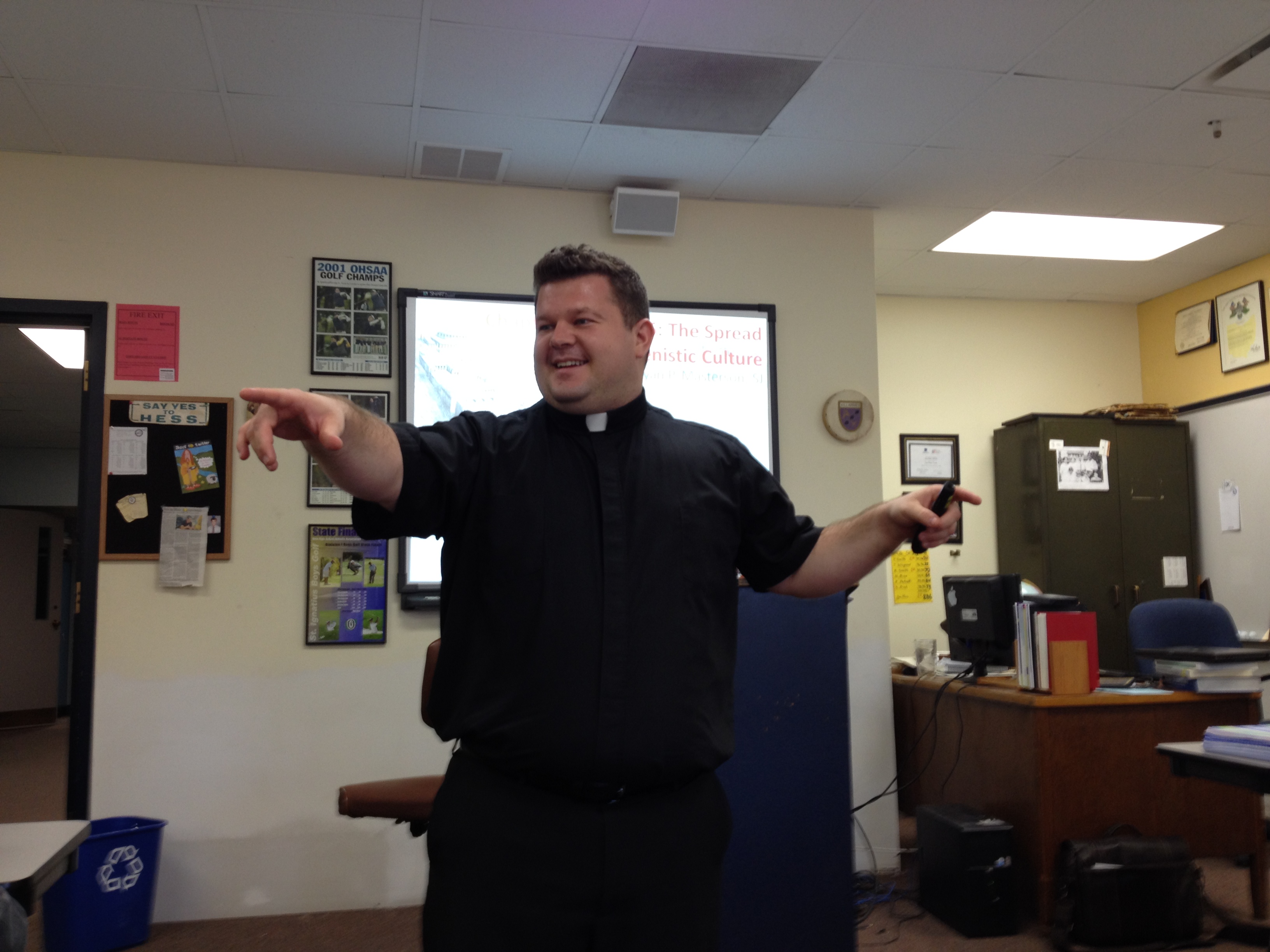
Matt Waldeck ’02: The journey of a “storyteller”

by Dominic Gideon ’14

Ambitious, young, and eager to expand his horizons, Matthew Waldeck ‘02 made a leap far from the Ignatius bubble and went 2300 miles away to a tiny liberal arts college in California called Pitzer College. His decision was not sparked by any overwhelming desire to be different, to escape Cleveland, to play college football, or to be able to party in the flashy lights of LA; Mr. Waldeck left to take a leading position in the Entertainment Capital of the World.

His desire to be in show business was likely sparked by the captivating storytelling of his parents, and his lifelong love for movies. Mr. Waldeck doesn’t see a big difference between his parents’ stories and big screen productions. The only distinction, he says, is the medium through which the story is communicated.

“I’ve been an actor, I’ve written, now I’m a producer,” he said. “Really, all it is is storytelling.”

As a child, he remembers spending his weekends endlessly watching narratives unfold through the visual medium. Subconsciously, Mr. Waldeck’s path to a movie career was slowly forming.

The Chagrin Falls native and St. Rita alumnus didn’t have much acting experience in his younger years. In high school the closest he ever came to his current job was making the yearly Spanish class video, which not coincidentally was his favorite time of year.

[pullquote]
“Really, all it is is storytelling.”
[/pullquote]

At Ignatius, he knew he wanted to go into entertainment. “There was some inkling,” he said, explaining that he knew intuitively he was destined for a career in film.

“That’s why I chose Pitzer; I just wanted to get close to LA and I would figure it out from there.”

Mr. Franzinger ’02, one of his classmates, wasn’t surprised Mr. Waldeck got into the entertainment business. He remembered Matt Waldeck as a friendly, funny, and quirky guy noting his hard work ethic, spot on Mr. Hennessy impersonation, and yearly “bowl of red” lunch.

Although Mr. Waldeck felt inclined to pursue acting, he dedicated much of his time in high school to athletics, especially football. At Ignatius, he ran track and was an integral part of the 2001 championship team as the starting safety.

“Football was very important to me, especially the camaraderie,” he said.

Mr. Waldeck also developed some useful traits as an athlete, including self-discipline and relentlessness.

He is convinced his education at Ignatius has been crucial to his later success. During his time at 1911 West 30th, Waldeck says he picked up many great life lessons and grew by having the “complete Ignatius experience,” learning formative truths which help him every day in his profession.

One example that stuck out to him was the personal strength he developed as a result of the competition he found at Saint Ignatius.

“You’re a small fish in a big pond,” Mr. Waldeck said. “The sooner you can figure that out about life, the better, because you’ll understand how hard you have to work.”

Two of the teachers he credits with helping him become who he is today are Mr. Dan Corrigan, his football coach who made him work harder than he thought was possible, and Mr. Beach, his English teacher, who gave him the confidence and skills to write, so important for his job.


Once in college, Mr. Waldeck jumped on all the acting opportunities he could get. He would search the paper trying to find auditions, then drive to LA to try to hook a job.  He developed a diverse portfolio including appearances in a K Swiss shoes commercial, and a television pilot with Stan Lee from Marvel Comics.

“I had success immediately which sort of spoiled me, because it was a much different ball game when I got out of college,” he said.

After graduating from Pitzer, Mr. Waldeck spent about four years hopping around from one short acting stint to another. He had roles in several short films, a few TV series, and a movie before he decided to try out producing.

“I kinda got burned out on acting,” he said. “Waiting in the breadline for your next job as an actor is not the easiest way to get stability.”

So he went back to Cleveland to work for Tyler Davidson, an independent film producer who has produced seven films including the highly acclaimed, award winning film Take Shelter, as well as Kings of Summer, a Sundance feature filmed in Northeast Ohio, and his upcoming film The Signal, for which Mr. Waldeck was an associate producer.

“Working for him was instrumental. He taught me how to do it,” Mr. Waldeck said of his apprenticeship with Mr. Davidson.

Now Mr. Waldeck has his own company which produces “horror, thriller, sci-fi films.”

[pullquote]
“You’re only limited by your own creativity.”
[/pullquote]

Most moviegoers know very little about the job requirements of a producer. Mr. Waldeck says the process is complicated and involves a surprisingly large number of people of the course of the process.

It all starts with someone bringing an idea to a movie company. Some producers begin working with the concept and do what is known as “development.”

“Next you would have to pay a screenwriter or writer director to write a script in hopes of attracting an actor, then that starts to become a package,” he described.

“Then you get a line producer, which is like an accountant. You come up with a budget of how much you can make the movie for. Then they’ll come to a guy like me who I’m a creative producer and also a financier,” he said. “They say we need $3.5 million for this movie. I raise that money and oversee the production to protect my investor’s money. So it’d be a co-production.”

Mr. Waldeck loves what he does.

“It’s a really cool job that I didn’t even know of until later in my career because it’s problem solving and it’s also very creative,” he said. “You’re only limited by your own creativity.”

One aspect he doesn’t like is the distance.

“It took 11 years to get where I am, and I want to get to the point where I don’t need to be in Los Angeles to have motion pictures. I think it would be fantastic, a great source of pride for the city,” Mr. Waldeck said.

“I love Cleveland, it’s a great city. And I think it’s kind of a blank canvas right now and it’s an exciting time to be here.”

He eventually wants to get a movie studio built in Cleveland.

“Albuquerque, Georgia, Bloomington, and Vancouver all have big film markets,” he stated. “I don’t see why Cleveland shouldn’t.”

One potential factor in helping expand the Cleveland film market is the Ohio motion picture tax incentive, in which the state gives 25% of the the movie production’s costs back to the film makers.

This incentive was the basis behind the decision by the makers of the movie Draft Day to switch from the Buffalo Bills to the Browns.

Mr. Waldeck also wants to give Ignatius students more film opportunities by working with Alumni Director Mr. Dan Malone to create a group called the “Industry Cats.”

“The goal will be to integrate you men so you don’t have to go 3000 miles away,” he said. “There’s a lotta lawyers and doctors at Ignatius, and their networks are very powerful and very helpful. I don’t see why we shouldn’t have an equally powerful and helpful network in the entertainment business.”


State of the clubs

by Anthony Ramirez ‘16

Saint Ignatius is fortunate to provide a home for a burgeoning community of student leaders – entrepreneurial souls dedicated to the formation of dynamic, innovative organizations that provide a space for like-minded students to succeed. Students who start clubs should be celebrated, though their ambition may sometimes outlast their organization. The purpose of this column is to provide a status check on clubs born during the course of the 2013-14 school year; may the 2014-15 year be equally productive.


Arabic Club— السلام عليكم, or “may peace be upon you, Ignatius.” If you want to learn how to speak and write in the most widely spoken language in the Middle East, stop by at an Arabic Club meeting. You will learn some basic phrases as well as the fundamentals of the Arabic alphabet, of immense importance in a time when  Arab nations are at the center of so many international events.

Since its inception in the second semester of this year, the Arabic Club has garnered over twenty active members, with about a dozen showing up to each meeting to share their knowledge or learn Arabic. The original purpose of the club was an introduction to Arabic, but with an abundance of advanced speakers the club has expanded its purpose to more intense learning.


Archery Club— Bullseye! After a challenging, year-long application process, the Archery Club was approved in the second quarter of this year. With thirty active members and and ten to twenty showing up to each meeting it is the largest new club of the year. Teenage boys have flocked in droves to celebrate a sport that is martial in theory but jovial in practice. Archers practice shooting from different distances, and occasionally hold scored tournaments. The members are continuing to improve their bowmanship and the club looks to be shooting straight for years to come.


College Experience Club— Looking to travel and find out more about your life after high school? If so, the College Experience Club is right for you. The College Experience Club was formed in the late third quarter this year in collaboration with the college counseling department to provide a way for Ignatius students to visit different colleges around the country. Significant interest has been shown in college travel by many students, although the primary club activities will have to wait until early next year. The College Experience Club is a great way to show colleges your interest, and the moderators expect to see the club thriving in the future.


Hydroponics Club— Innovation and creative design in gardening is the core focus of the Hydroponics Club. The club was formed early this year and has seen great results to date. Members construct systems to grow plants hydroponically, which means using indoor agricultural systems in which plants are immersed in water, not soil. The produce is then given to charity. So far, over five pounds of lettuce have been produced while tomatoes and peppers are in the works. Currently the Hydroponics Club has eighteen active members with ten to fifteen showing up to each meeting, but the members expect some growth over the years because of the unique combination of opportunities the club provides. Melding agriculture, engineering, and charity, Hydroponics Club is one of the most innovative clubs you can join at Saint Ignatius.


Nerf Club— The Nerf Club, or the self-proclaimed “most prepared club in 25 years,” is a club for those who want to have fun with Nerf guns. The club’s senior staff had dozens of different play styles and games planned by the time of the first meeting, following an extensive review process. The club finally gained official approval in the third quarter following a semester of trying to convince Mr. Hennessey and Mr. Franzinger that it merited school recognition. With twenty-nine members it is around the same size as the Archery Club, which may inspire a fearsome rivalry. The Saint Ignatius Nerf Club (SINC) aspires to provide a natural home for those interested in participating in foam-bullet barrages or learning advanced engineering techniques through modifying (“modding”) NERF technology. The club hopes to have gained momentum following the first official competition on May 17.

The Eye: newspaper, or newsletter?

by Alastair Pearson ’14

Editor-in-Chief

The twelve crinkled pages between your hands have been painstakingly consolidated from hundreds of hours of labor by dozens of skilled staffers and dedicated editors, a team of passionate, professional journalists you should be proud to call your classmates, and whom I have been deeply honored to serve as editor-in-chief.

I do not mean to besmirch their accomplishments when I say that the institution we work for – the Eye – is immensely flawed, nor do I intend to taint the school whose student body we serve when I say that current policy has forced and will force the Eye to exist as a failed caricature in the shadow of its potential self. We are not what you, the students, deserve, and we are not the newspaper that this community’s ideals and the long-term best interests of the school demand.

We are subject to a degree of censorship that, even if almost always exerted through passive means like repeated requests to review submissions or implied refusal to publish, has a seriously detrimental impact on the quality of our paper. Let me be clear that this is not in the day-to-day management of the paper, that we suffer mainly because we feel we cannot pursue certain topics or express certain opinions – so we never try in the first place. Thus we cannot satisfy the student body’s yearning for a publication that actually articulates their diverse and heartfelt views, nor do our reporters have the freedom to seek the answers to stories that strike at the core of what it means to be Ignatian.

In practice, this means that though editions of the Eye do not receive prior review – we do not have to submit a copy of the issue for administrative approval before publication – our most important stories are changed due to interference in the editorial process, weakening editorials or undermining coverage. Our moderators are put in the uncomfortable position where they have to choose between censoring and potentially undermining the Eye, or aggravating their employer.

Our inability to effectively voice the concerns of our student readership was put on full display these past few weeks, when the administration rolled out the new mandatory random drug-testing program and we found our efforts to publish our opinion editor’s anti-drug testing editorial abjectly throttled. Dozens of drafts rattled back and forth between editors and the moderators, but we could not produce any version acceptable to the administration, and even after conceding vital components of the essay it was ultimately discarded because of tone.

If the administration hoped to control the message, it was utterly unsuccessful. The editorial, “A Contemptibly Misguided Attempt at Reform,” by Ben Seeley, was published on Scene Magazine’s website and has since obtained over 1300 likes on Facebook while igniting a firestorm throughout Cleveland. Serious publications like the national magazine Reason covered the editorial, and most focused primarily not on the substance of the work – an excellent, well-reasoned argument consisting of ideas commonly voiced around campus – but on the fact that the students could not have their ideas heard.

Because it is intolerable that students would be denied the basic freedom to discuss an event as obviously newsworthy as the implementation of mandatory, randomized drug-testing, an issue which regardless of personal opinion will affect each and every student at an incredibly individualized level.

Your hair will be tested, the contents of your body scrutinized, your future at stake.. And those students who, like Ben Seeley, maintained the conviction that this is the wrong route for our school to choose – regardless of whether they are right – did not have a representative newspaper to which they could turn and expect publication of a reasonable editorial in a reasonable and timely manner. This, too, is intolerable.

We are a private school, and, as was the case with the debate about drug-testing, our administration can choose to hide behind the veil of legality and assert that the fact that the law affirms the permissiveness of its actions also means that those actions are right.

We can continue to accept a status quo where our conscientious, devoted moderators can be made to feel that their professional success is contingent upon the newspaper toeing the school’s line. We can be intellectually lazy, allowing the newspaper to fall into a state of benign neglect where every page is filled with toothless investigations and vacuous press releases. We are faced with a choice between a newspaper and a newsletter.

That essential distinction rests on whether or not our newspaper faces crippling censorship or whether we affirm freedom of speech, which is in turn dependent on whether students make the decisive editorial choices; not teachers, not administrators.

This year, every article in the Eye has been assigned and edited by students, and I firmly believe this has meant a publication that is both more representative and simply better written, more suited to be the public face of a school as renowned as Saint Ignatius and more ready to change with the times. It has resulted in a system that routinely produces articles like the one written by Ben Seeley, which exemplifies the exact kind of eloquent, cogent, independent thought that a Jesuit education is supposed to develop.

The school funds the Eye, and the administration has used this authority during my tenure to delay Eye articles, which has resulted in those articles missing publication; whether intentionally or not, controversial pieces were not printed. This is informal censorship, just as generally deplorable as any other brand.

What I suggest instead is that the administration recuse themselves from the editorial process in every instance except one in which the most basic foundations of the school are being violated, and that students assume the full powers and responsibility that comes with being vested editorial control. If you want this newspaper to reflect the views of the student body, and be more than a once-monthly administrative pamphlet that happens to be written by students, you will support this proposal. Anything less insults the intelligence of our student body, denies the competence of our editors, and betrays that most foundational of Ignatian tenets: being open to growth. Ideas should not be smothered because they are different.

Looking for “morality” in all the wrong places

by Ben Seeley ’14

Last week, the Diocese of Cleveland announced it would be adding a “morality clause” to the contracts of all Catholic school teachers. (Editor’s Note: As employees of a Jesuit school, teachers at Saint Ignatius are not subject to the new contract). The new language prohibits teachers from publicly supporting positons contrary to Church teachings–about abortion or gay marraige, for instance–and from engaging in a whole list of behaviors, including the sending of “improper” tweets, texts, or emails.

The Diocese opens itself to easy criticism. What they fail to consider is that they add further disincentives to entry to a profession featuring a preexisting drawback: a lower salary. If it’s a deeper, more diverse labor force the Diocese wants for its students, placing severe limitations on the job isn’t exactly going to help.

Of course, the prohibited actions aren’t necessarily easy to identify, which is perhaps the reason the Diocese insists on them—as guidelines as a part of a PR move, not mandates intended to undermine teachers’ individual rights. But still, a contract is a contract. Teachers’ jobs are placed in jeopardy for violations as tenuous as sending conceivably distasteful messages in private or engaging in premarital sex.

The teachers aren’t forced to sign the contract, but failure to do so is a virtual guarantee of unemployment. And with today’s job market, the risk carried by a failure to comply is too daunting to consider. Resultingly, the teachers are coerced into a loss of liberties they didn’t sign up for. That’s unfair.

All of this comes in light of a new papacy that has stated outright its intention to turn its sights on revitalizing the Church, and not necessarily on adherence to Catholic expectations of an individual’s personal life. The belief of Catholics may be that something like homosexual marriage is wrong, but that doesn’t mean a crusade against gay marriage should be the priority. But that’s how it seems to have become for the Church, and Francis won’t stand for it.

The reality of the situation is such that the Church isn’t doing so well in places like the U.S. and Western Europe. So does the Diocese think a dictatorial overstep like this is the solution? Is focusing on the Church’s nuances, and not the Church itself, really imperative, or even recommended?

What’s perhaps most unsettling is the doors the “morality clause” opens for future breaches of liberty. For example, though I’m not someone in favor of drug testing teachers, would that not seem a logical next step for the school with the new clause? If it’s expected, and explicitly outlawed, that some teachers will be violating Diocesan policy, it should be no further misstep to act on that suspicion.

At the end of the day, the people all just fall victim to organizations bigger than themselves and submit to that victimization. The cycle continues, and we drift, wearily but together, into the pathway of our bosses and their prescriptions. Silenced are our voices and rendered futile our intentions, but fear not: for we have leaders to lead us back to the light.