Home Blog Page 92

It’s only weird if it doesn’t work: Ignatius athletes share their pre-game rituals

by Pat McGuire ’14 and Cole Larson ’14

There is no established routine for a varsity football pre-game routine, but seniors from across the depth chart have a set of traditions they rely on to get them ready to compete.

Dameon Willis, Senior, S/LB
“I always sit in the same seat during mass, eat half of my sub, do 48 pushups for every minute of the game (gotta play the full 48 minutes), and pray at the goal post when I first get off the bus. I have a core of three songs; Meek Mill: Dreams and Nightmares, Katy Perry: Roar, and 2 Chainz: 36.”

John Thomas, Senior, QB
“I stop at Lehmans Deli in Westlake (go to is a turkey bacon club sub) before every game. My favorite pump up song is Radioactive by Imagine Dragons.”

Enzo Cannata, Senior, HB
“Pregame rituals are: I sit in the same seat in Mass, eat three granola bars and a bottle of water, and sit next to Rob Ricotti on the bus. I usually listen to any rap song before the game.”

Jack Hyland, Senior, WR
“I wake up at 9:30 A.M. and get my swag attire for the evening ready. Take a shower and shave my ankles for the most perfect tape job by Saint Ignatius’ own Mr. Hank Gaughan. I watch some film, double check my stuff then I’m off to Cleveland to pick up the most frightening safety in North East Ohio, Dameon Willis Jr. We make a trip to Subway in Ohio City, then we are at school at 1:45 sharp. This gives me just about two hours to get my stuff ready and to get my mind right before team mass. Pump up songs: Money and the Power by Kid Ink, Radioactive by Imagine Dragons, and In The Air Tonight by Phil Collins.”

Mike Siragusa, Senior, WR
“I always wear the same clothes to mass and sit in the same spot. I always wear the same compression shorts and socks during the game, and I sit with Tommy Stuhldreher on the bus every time. That is all I can reveal…gotta keep some a secret. Pump up songs: any 2 Chainz, Lil Wayne, or rap. The songs change with the game.”

Running with the pack: Senior Athlete John Nemes make transition from Rugby to X-Country

by Pat McGuire ’14

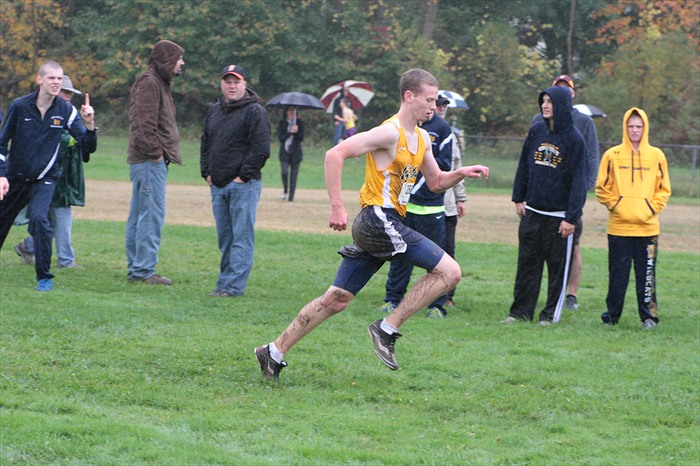
Senior Cross country runner sat down with Eye Sports Editor Pat McGuire to discuss his athletics career.

Q: John, you played rugby for two years in the Warrior rugby system. Why did you decide to leave the sport?
A: I left because I just wanted to experience something other than the physical nature of rugby and distance running seemed like a great option to stay in shape. I also thought running long distance would be pretty easy but it really isn’t when you get into it.

Q:
How were you and the team able to deal with the ups and downs of the 2013 season?
A: Our team as a whole put in effort every single day of the season and never took days off or took it easy when we were sore or tired. We also made sure to get extra workouts in after practice and eating well.

Q: Do you find any similarities between running cross country and playing rugby?
A: Definitely, both sports involve pacing and conditioning as well as the knowledge of when to exert amounts of energy and when to hold back and save some for later. Also, because both sports are continuous, they involve players/runners to make adjustments on their own when something unexpected happens.

Q: What was it like to be a part of such a successful season as a Wildcat harrier?
A: It was great. I was sort of worried as the year started off slow but we kept our composure, became more competitive each week, and the entire team put in a lot of hard work in August and September to run well at the end of the year.

Q: Do you plan on pursuing either of these two sports in college?
A: I am considering possibly running either cross country or track at the next level.

O’Rourke’s IceCats eye another successful season within new league

by Bill Huesken ‘14

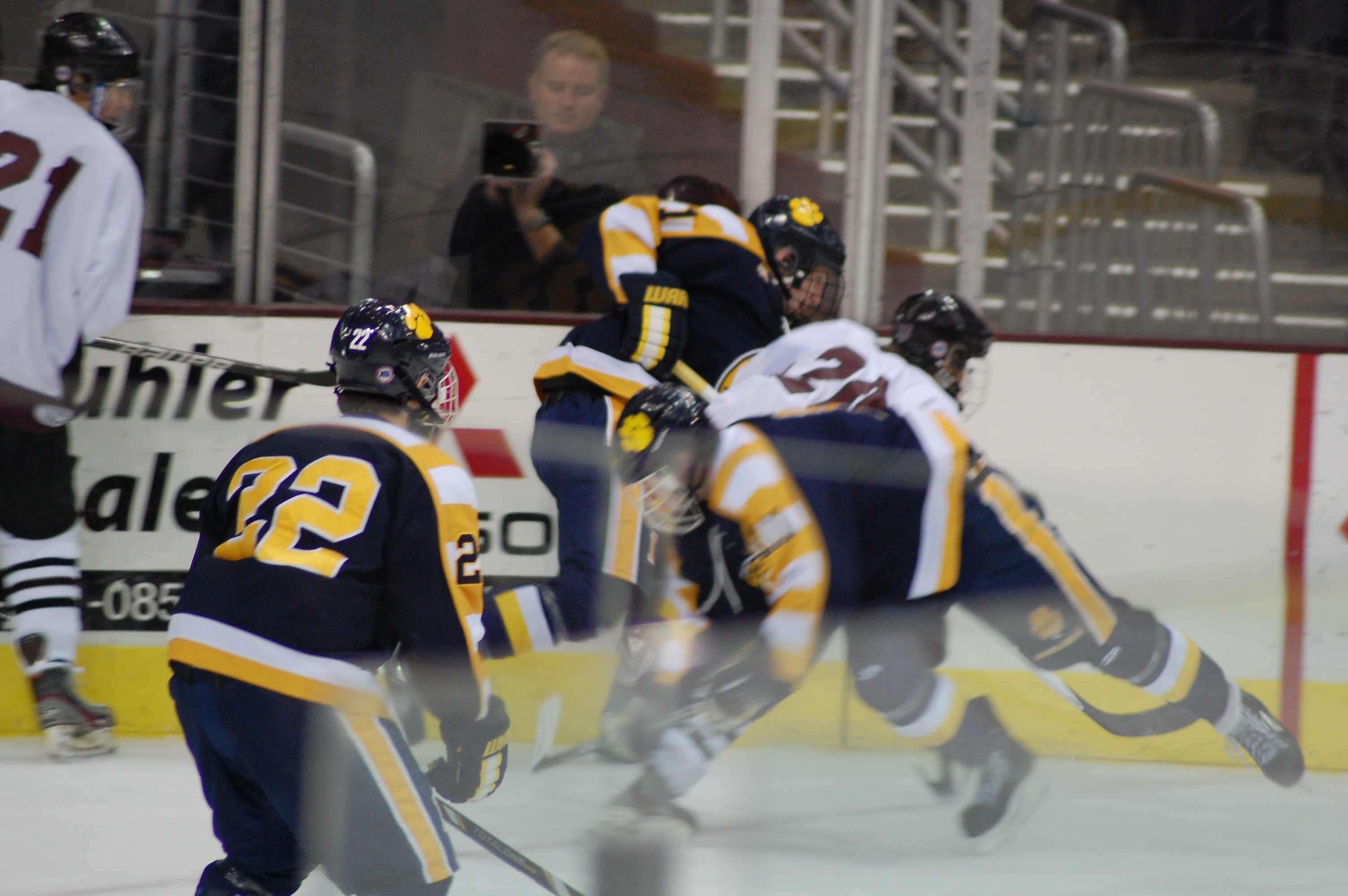
The 2013 edition of Saint Ignatius Hockey features a very deep team with a trademark aggressive style. The team, led by captains Beck Schultz ’14, Harry Smith ’14, Kevin Spellacy ’14, and Jack Weigandt ‘15, was ranked first in a coaches’ poll for the league.

Despite the preseason accolade, this team will not get ahead of itself.

“We come to win. We don’t shrink from our ranking. But the key that we’ve learned from the past several years is to peak at the right time,” said Mr. Pat O’ Rourke, the head coach.

Mr. O’ Rourke said this is deepest team he has coached.

“With four full lines, we can wear out teams that only play two or three lines. Our team is in great shape,” O’Rourke said.

The team, described by Spellacy as “the hardest working team I’ve been on,” has spent countless hours conditioning in the offseason.

After graduating star center Miles McQuinn, who totaled 115 goals and 103 assists in his career at Ignatius, the team will not look to one single player to fill in.

DSC_0009“We need everyone to produce, and I feel that everyone can,” Smith said.

O’ Rourke added that while the team may not have one player who can score 50 goals, it has many players who could potentially score 20 or 30 goals.

All three goalies from last year graduated. The void will be filled by sophomores Wes Deacon and Dylan McKeon. To support the young goalies as they gain experience, the defense will look to play very aggressively and to block shots.

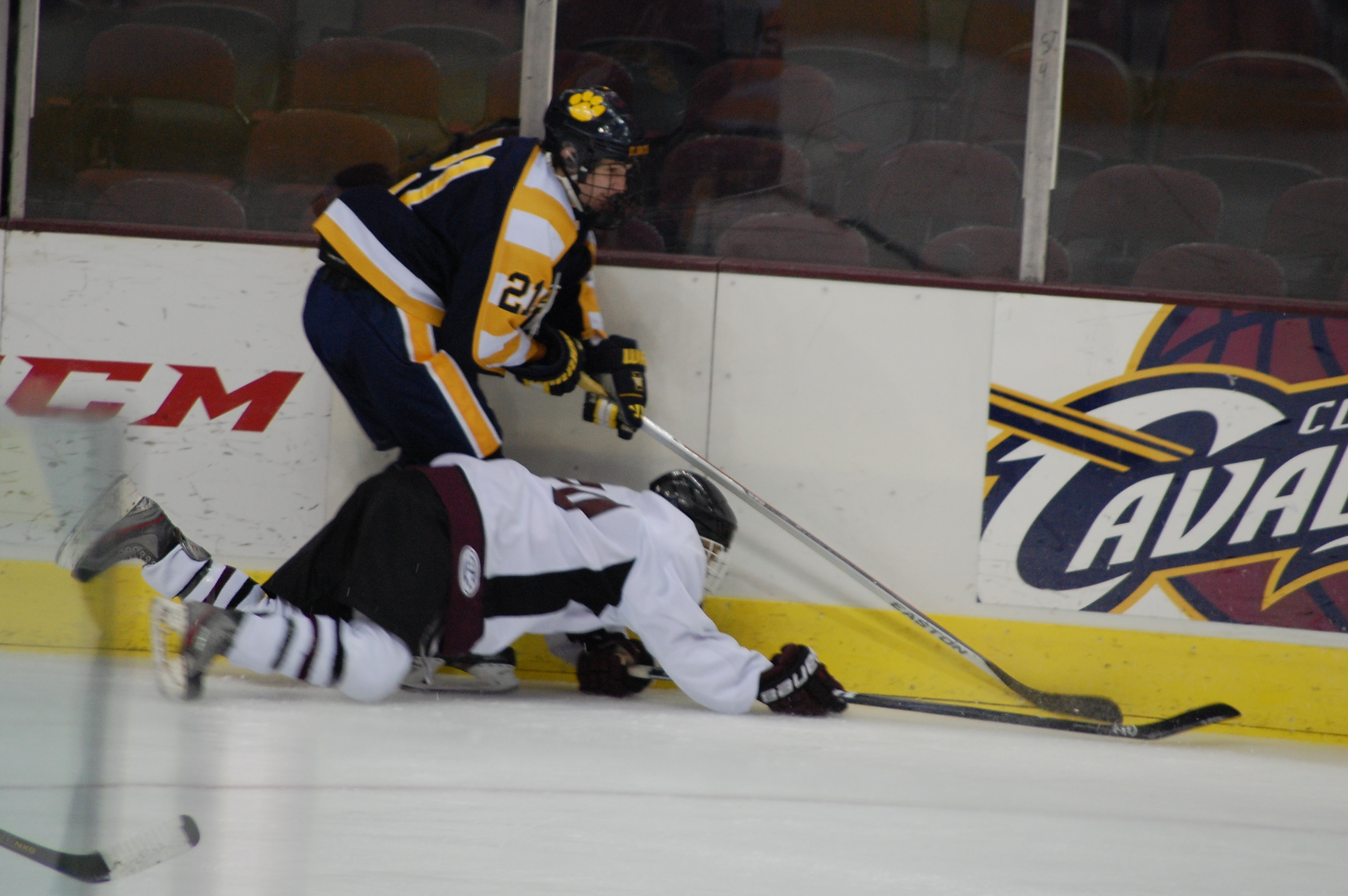
“We want to be physical and make teams think twice about going for the puck in the corner,” said Smith.

The team opened its season at 4:30 p.m. t Quicken Loans Arena against the always-strong University School with a 4-3 shootout loss. Ignatius plays St. Edward in Lakewood on Jan. 4 and at home in Brooklyn on Jan. 24.

The ’Cats will play a total of six games in Brooklyn, five in Lakewood, and two tournaments in Strongsville. They also will play two games on the East Side, giving fans from all sides of town plenty of opportunities to cheer for them this year.

Impact athletes: The Eye’s fall MVPs

by Cole Larson ‘14

Cross Country
MVP: Luke Wagner, Sophomore
Notes: Finishing second overall in the Wildcats’ first meet was just a sign of things to come from sophomore sensation Luke Wagner. One week later, Wagner was at it again, this time taking first overall in the annual Avon Lake Early Bird Invitational. Wagner also finished first in the Galion Cross Country Festival. Then came the post season. Luke took second overall in the district meet with a time of 16:40. Then, keeping his momentum, he third overall in the regional meet at Tiffin. In the state meet, Wagner ended up placing 79th with a time of 16:40:44, helping the team finish 7th. His most memorable finish to a race came at Galion where he raced step-for-step with a racer from Hilliard Davidson, but Luke blew past him in the final 100 meters to place first overall.
Other Notable Athletes: Tim Trentel (10), Elliot Thorkelson (12), Jim Rogers (10)

Golf
MVP: Jack Coyne, Senior
Notes : After a solid start to the year, Jack Coyne really started to catch fire when he hit a score of 69 (one under par) and finished first overall at the University School Invitational at the prestigious Windmill Lakes golf course. The following week, Jack topped his performance with a score of 68 on the south golf course at Firestone Country Club (Site of the Bridgestone Invitational) at the Archbishop Moeller Invitational. That score of 68 was good for Jack to take third place in the outing. Coyne would go on to have a fantastic season that concluded with him shooting a 77 in the district tournament and a two day score of 158 in the state tournament. Both scores led the Wildcats in both respective tournaments. Coyne’s leadership showed through for Coach Brian Becker’s golf team, as Jack led the young and talented team through very difficult sectional and district tournaments all the way to a state tournament appearance.
Other Notable Athletes: Peter Malik (12), Kevin Duncan (11), Harrison Vonderau (10)

Soccer
MVP: Colin Cleary, Senior
Notes: Throughout the entire Wildcat soccer season, whenever the team needed an offensive sparkplug it seemed that senior co-captain Colin Cleary would step up. However, Cleary’s talents offered more than just a quick scoring option. The senior co-captain excelled in nearly every aspect of the game of soccer. From penalty kicks to corner kicks to crosses into the box, Clearly utilized a combination of speed and tremendous touch to set up teammates or even himself for scoring opportunities. Cleary also served as a hard nosed all-around player, most evident in the playoff game against the Saint Edward Eagles. All-in-all the 2013 season was a success for the senior co-captain.
Other Notable Athletes: Mikal Outcalt (11), Matt Ivancic (12), Matt Nigro (11)

Football
MVP: Dameon Willis
Notes: Unfortunately for Wildcat opponents this season, “Buffet Time” was in full effect on Saturday nights and Dameon Willis was hungry and ready to eat. Willis made his initial mark with an early season statement against a tough Mentor team. Willis limited Mentor’s star receiver Brandon Fritts to just two catches the entire game, leading the Wildcat defense in an effort where they gave up just a single touchdown to the high powered Cardinal offense. Willis, starring at a hybrid position of safety and linebacker, struck fear into the eyes of opposing quarterbacks, posing as a constant threat to blitz or to intercept a pass. Committed to Indiana next year, Willis looks to stay hungry and on the prowl for many years to come.
Other Notable Athletes: Nick Fabian (12), Mike Siragusa (12), Chris Keane (12)

School must balance discipline and free speech

by Alastair Pearson ‘14

As you’ll read in our news section, senior Richard Benninger made a bold proclamation over the school intercom on November 12. The fatal words: “It’s boot season!”

On that day, when a light sheen of snow covered the mall, Benninger may have intended to gently mock the school’s strict standards for personal decorum. But Mr. Hennessy has long maintained that boots can only be substituted for dress shoes when there is actually snow on the ground.

Whatever his motive, Benninger was promptly removed from the morning announcement team. His dismissal is not by its nature a cause for concern–there is a difference between infringement of freedom of speech and a clear expectation of professional behavior from those students entrusted with all-campus communications access.

Student announcers have a responsibility to deliver important information to the student body: club meetings, upcoming events; even, perhaps, seasonal changes in the dress code. Most of them do inject a personal touch to the script to add levity to an otherwise monotonous five minutes. Few current seniors will forget Harrison Stadnik’s gleeful mispronunciation of the “Blood Club,” or John Fanta’s signature laugh.

The standard that must be established is what constitutes an acceptable breach of decorum. When Camden Stacey was dismissed from an announcing role last spring after introducing himself as “your friendly neighborhood white kid,” students around campus were jolted out of their mid-morning reverie. Stacey’s utterance seems significantly less innocent than Benninger’s, and, even if delivered ironically, unintentionally crossed a line that necessitated some kind of meaningful disciplinary response from Mr. Hennessy.

Benninger’s immature joke did not. He satirized the inaugural day of “boot season”: a miserable, gray, frigid time of year when Ignatius students trudge through mounds of snow between classes, when biting winds chip at our ears and essentially the only bright spot in our day is our ability to take solace in warm feet and coffee.

If the administration feels that adherence to the script must be mandatory for student announcers,that is their choice. But on behalf of Benninger and on behalf of a student body that deserves some degree of reasonableness and lassitude, the measure we hold our announcers to – and by extension ourselves – has to allow for human error.

If Stacey offended, then perhaps he should have been allowed to apologize. Losing his position for a one-time mistake seems unfair. The discrepancy is even worse for Benninger, an active member of Student Senate and numerous other student organizations, including the Eye. If they needed to be punished, it should have been through something like a public apology. Justice is supposed to be proportional.

For students to grow, they need space to err. For campus to be vibrant, free speech must be tolerated. We are only human, and we should be allowed to move off the beaten path on occasion.

To serve here or to serve there—that is the question

by Jacob Rossi ’14

We sit in theology classrooms everyday and study how Christ lived, and yet we far too rarely embody the ideals Christ himself held. I don’t want this to come off as a scathing indictment of the boys at our school because I am right there with them, but it seems to be the case that only the big-name service opportunities are the ones students engage in.

I went to a CAT meeting earlier in the year when I thought football practice would be delayed due to thunder, and the room was packed. If you showed up late, you were sitting on the floor. That room was filled to capacity. So it would be doubtful that the problem some of these programs are having is the lack of desire to serve from the student’s end. Still, it would seem the students just don’t get it.

The desire is there, so the situation plays out something like this: a lot of guys try to sign up for the more big name service initiatives and when those are full then everyone walks away hoping that next time they can get their name on the list. But I contend that this method is not only flawed, but it blinds us completely.

I prefer to think of service as a give-and-take. Sure, we’re giving to others, but they give us only as much as we give them. Too often we lose that second part, and the people who walk away after their desired list is filled view service in a different way. They view it as a means to feel good about themselves, to be recognized as a do-gooder, or to get on someone’s good side. These motives are completely selfish and not in the spirit of Christian service. When walking into a CAT meeting, the first thing one has to understand is that he is there to serve others before himself. If he can do that, then he wouldn’t think twice about signing up for a “less popular” service activity, and I can promise he will get so much more out of his future service experiences.

What’s in a name?

by Ben Seeley ’14

Tradition’s nice if you ask me. It’s a reason for connection to our past and it’s a hope that our future appreciates the works of our present. Here at Ignatius, tradition has come to form the backdrop of all we do, be it service, athletics, or academics. Yet comforting as tradition may be, it doesn’t mean that it demands subscription or precludes criticism; in fact it should encourage such practices.

“Tradition is the illusion of permanence,” writes Woody Allen in one of his lesser-known films, Deconstructing Harry. He has a point. It seems to be that we grant unquestioned acceptance to what was the practice of those before us when we describe those practices as “tradition.” And it would appear that the tradition of language is much the same.

In a recent discussion with Mr. Arko, he spoke of the phoniness and unrighteousness we embrace in using traditional titles, like those of doctors. Dr.’s are Dr.’s in the operating room, and as soon as they step outside that place they return to being our brothers and sisters.

They’re people as much as any of us are, who aren’t any more or less important than you or I. They have names they go by, struggles they’re plagued by, experiences they’re defined by.

They’re human—just like the rest of us.

So, naturally, if contemplation of traditional, titular roles is called for, such begs the question: why not do so here on campus?

By referring to our teachers as misters and misses we pander to a traditional societal construct rooted in inequality. We students accept (and institutionalize) the very divide that too often prevents friendship and camaraderie among students and teachers, opting instead for adoption of the hierarchical status quo. It’s demeaning to the students and awkward to the teachers, who at the end of the day just want to find common ground with their students.

Despite how it may seem, the idea of a first-name basis with teachers isn’t novel or radical; it’s actually a practice already pervasive here in the U.S. among Montessori schools and the like. What’s more, aside from the impact first-name relationships have on equality, they work to relieve tension and—by extension—minimize separation. A class in which teacher and student see eye-to-eye is a class conducive to growth and reception. It’s a pedagogical truth.

Such a system wouldn’t be an affront to teachers’ control of their classes, but rather would serve as a statement of equanimity with their students. It would be a progressive attempt at finding compassion and unanimity in the classroom—foregoing disunity and divides in the process.

I’m not making this proposal for the sole reason that I want to be able to refer to Mr. Arko as “Dennis” in conversation (even though I most certainly do). I just want the world in which teachers are stigmatized as malevolent overseers to come to its inevitable resolution. I want to put an end to the perception of teacher as dictator and fortify the teacher’s place as learned equal. I want an environment where both student and teacher open themselves to growth.

And in order to be truly open to growth, we must be willing to recognize when a shift in paradigm is called for and an end to tradition is necessary. The world is moving forward; let’s move right along with it.

Freshman flood SIHS halls

Ignatius Men Forever

by Jack Eckman ‘15

The class of 2017 is one of the largest classes St. Ignatius High School has ever had. Over 420 freshmen were on campus at the start of the year, about 40 more than the average class.

But future classes may not be as massive in the future. The Director of Admissions, Mr. Pat O’Rourke ’90 explained that the rise in class size is due to the confluence of a number of factors.

“There were a number of contributors that made this class so large,” O’Rourke said. “A big senior class graduated, not as many students in the class of 2017 declined admission, and we let in more students than usual.”

As a result of the big freshman class, the student body at the start of this year was larger than usual – 1,494 according to the school’s website.

While the student body is not at the saturation point just yet, O’Rourke said that another class this size would push the limit.

“We want to bring in as many smart and talented kids as we can, but not to the point where it is too many to effectively teach and provide an environment that stimulates growth,” said O’Rourke.

This means that incoming classes in the future will revert back to an average of about 380 students. And although there will be a big void to fill when the class of 2017 graduates, the admissions office and Board of Trusetes are trying to evenly distribute class sizes in preparation for that reality.

“Ultimately we will handle the admissions process as the Board sees fit, but do not expect large incoming classes to be standard,” O’Rourke said.

Mr. O’Rourke said that prospective student interest for the class of 2018 is promising.

“There will be about 800 taking the admissions test, which is more than in past years, and judging from the scores that came back so far, it looks as if there will be far more Scholars than usual,” O’Rourke said, referring to a recognition program for exceptionally high-scoring students.

This means that though the school is not necessarily growing in numbers, it is attracting more top students.

The class of 2017 is an anomaly as far as total number of students per class is concerned, but it is indicative of a new trend at St. Ignatius. Each year more of the top students from local grade schools are picking St. Ignatius as their top choice, which may bode well for St. Ignatius’s reputation as one of the top high schools in the Cleveland area.

Mitchell’s Ice Cream to open Ohio City location this spring

by Sam Royer ’15

Founded in 1999 by brothers Pete and Mike Mitchell, Mitchell’s Ice Cream has come a long way. With eight Cleveland shops already in service, the brothers’ next big adventure is opening a new shop and headquarters right here in Ohio City.

The shop will be located on West 25th Street, where Ohio City’s Moda Nightclub previously ran until 2006.

“We feel good about taking a historic building, about one hundred years old, and investing in the space to bring out its original charm and character,” Pete Mitchell said.

Aiming to reinforce the Mitchell’s roots as a local Cleveland company, Mitchell couldn’t be more excited about the move.

“Three or four years ago when we realized we needed a larger kitchen to make our ice creams and related treats, we decided that we wanted to open the new Kitchen and shop in the heart of the city,” Mitchell said. “We have always thought of ourselves as a Cleveland company.”

Aside from simply loving the energy and vitality of Ohio City, the brothers are also thrilled to become neighbors to Saint Ignatius.

“Over the years, we’ve had the great pleasure of getting to know many Saint Ignatius students who have worked at one of our shops in the suburbs. We hope to be helpful to Saint Ignatius, whether it be a donation to a cause they are involved with or a place for students and their families to come after school events. We’re looking forward to exploring the ways we may be able to help each other out,” Mitchell said.

The change in location isn’t the only advancement the company is making. With the new shop, the Mitchell brothers plan to make their kitchen completely visible to customers to provide a more fun environment.

“Our kitchen will be on full display for people to see what goes into every spoonful of ice cream they enjoy,” he said.

Aiming to open for business by March 2014, Mitchell believes the new shop and headquarters will be a great addition to Ohio City.

“There’s no place we’d rather be establishing our roots than in Ohio City in Cleveland,” he said.

DiploCats garner seven awards at debut conference appearance

by John Selby ‘15

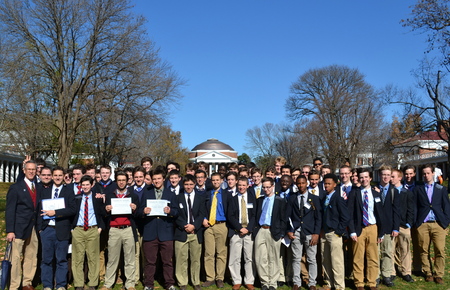
Fifty-two Saint Ignatius students shook Mr. Arko’s hand as they climbed aboard the Cleveland Southeastern Trails motorcoach that was bound for the prestigious University of Virginia in Charlottesville, VA.

But this was no traditional athletic team. This is the kind of team that uses pragmatic reasoning as the ball, parliamentary procedure as the rules, and debated resolutions as the scoreboard.

But all the aspects of the traditional sporting teams are still present: the chemistry and camaraderie needed to succeed as a group, veteran leadership, and months of preparation before the actual game.

The team in question are the J.C.W.A. (Junior Council on World Affairs) Diplocats who compete as a delegation in Model United Nation Conferences held at various universities across the nation.

Model United Nations seeks to educate participants about current events, topics in international relations, diplomacy, and the United Nation’s agenda through the simulation of United Nation committee sessions at conferences of hundreds to thousands of high-school delegates.

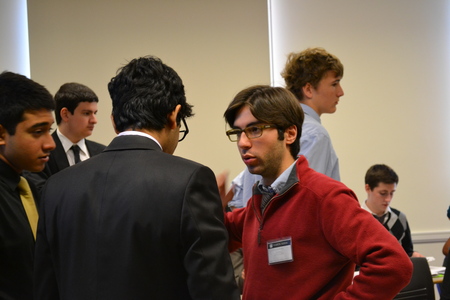
At conferences, delegates from across the country meet in their respective committees, the culmination of months of research heading into the conference. Delegates gather, collaborate, debate, and consult with each other in order to write a resolution that tries to address a pre-determined topic like child labor, United States policy towards China, or the 1967 Nigerian civil war.

“It was my first love at St. Ignatius,” says Kellen Dugan ’14, president of JCWA. “It’s shaped the man that I’ve become, and it’s helped me achieve things that I could have never achieved without it.”
VAMUNtom
The Saint Ignatius Model UN team’s most recent competition was held at the 33rd session of VAMUN (Virginia Model United Nations).

Delegates departed from Ignatius after school on Thursday, November 7th on an 8-hour bus ride to the University of Virginia.

The august college campus was the backdrop for an extremely competitive weekend of far-ranging debate and diplomatic discussions.

Sample committees from the conference include the Papal Conclave in which Charlie Heintel ’16 and Ben Seeley ’14 competed – Ben represented the Jesuit community well as he was elected Pope and chose St. Ignatius as his new papal name – as well as NASA 1961 in which Kellen Dugan ’15 and Tyler Delhees ’14 competed, and the Iranian Revolution in which Tom Horan ’14 represented the Ignatius delegation.

This was the first time the Diplocats attended VAMUN, an upper-level competition attended by schools including top-five nationally ranked Horace Mann, a New York private school whose delegates opposed Ignatius delegates in almost every committee. The Diplocats performed well and received 7 awards, including 5 Verbal Commendations , won by Andrew Beddow ’14, Alastair Pearson ’14, Ben Seeley ’14, Richard Kraay ’14, and Zach Stepp ’14. Two team members won extremely prestigious “paper” awards, an Honorable Mention for Kellen Dugan ‘15 in the NASA 1961 committee (equivalent to third place in committee) and an Outstanding Delegate for Tom Horan in the Iranian Revolution committee (second place).

But JCWA is about camaraderie as well as competitiveness.

“Being on a bus for 20 hours is not fun,” admits Brian Koehler ’15, a first time Model UN participant, “but what is fun is being on a bus for 20 hours when you can share experiences with 51 other people you like and respect.”

Whether it be the football team or magic the gathering or the rock and roll club, a bond is formed between the members of a close-knit group of students.

Members say that JCWA is not something to join because it looks good on a college resume. JCWA gives students opportunities made available only once in a lifetime.

“ [JCWA is] a club that teaches strategy, confidence, and compatibility,” Dugan said. “Kids that join never regret it because it teaches skills that are necessary to be successful in life.”