
Home Blog Page 68

After premature finish last season, O’Rourke’s Ice ‘Cats hungry for another shot at state championship

by Carter Spearry ‘16

It ended on a cold afternoon in March. What was supposed to be a team who would fight for another state title, fell short against Saint Edward in last year’s District Final 3-2. There is a bitterness in the air around Saint Ignatius hockey – they want revenge.

“We can’t take any team for granted. We will be sure to play at one level all year, and that’s State Championship-caliber hockey” said junior defenseman Seth Whitney. And that they must if this team is ready for a State Championship run. This year’s seniors have ended their last two varsity seasons with sour tastes in their respective mouths. 2014 ended with a dramatic 7 OT 1-1 tie with Sylvania Northview as the ‘Cats were declared Co-State Champions. 2015 ended in an aggravating 3-2 loss to that team from Lakewood in a game which saw the ejection of a handful of players from both sides.

The goaltender will be none other than three year varsity starter Dylan McKeon ‘16. “I think the key for defense this year is to stay positive. We have a good core of defensemen coming back who have a lot of talent but not much experience” said McKeon. McKeon posted a 91.2% save percentage and an impressive 1.58 goals against average. “My experience over the last two years has helped me because now I know what to expect in every game. I’m used to the big crowds and the big game environment.” Coach O’Rourke will have one of the best goalies in the state leading his defense this year. Look for McKeon to be the anchor of the defense.

With all of the defensemen returning from a year ago, McKeon will have an extremely solid unit to protect him. Juniors Matt Wiegandt and Seth Whitney had very strong campaigns a season ago and will highlight the defense. Whitney is an aggressive defender who is never afraid to play the body at one end of the ice and then test the goalie on his own on the other end. Geoff Allman ‘16 will provide great consistency in the back.

The forwards will be lead by none other than Aidan Spellacy ‘16, who is regarded as one of the best centers in the state. As a junior, Spellacy notched 19 goals and provided 17 assists while spending several weeks out injured. Spellacy has excellent vision as well as a devastating shot. He has the ability to score north of 30 goals this year, and will certainly be administering passes with precision to his teammates.

Converting from defense to forward will be seniors Brian Russell and Cam Gerard. Both players were excellent as the team’s starting defensive pairing a year ago and will make an easy transition to forward.

Rounding out the notable forwards are Connor Koehnke ‘17, Jared Stepka ‘16, and Zack Kisel ‘16. Koehnke provides stick skills that make the faithful of Brooklyn Ice Arena ooh and ahh. Stepka has excellent speed and can finish very well around the net. Both Stepka and Koehnke registered 25 points a season ago. Zack Kisel will be the bruiser that teams earmark as the enforcer. Although physical, Kisel scored 11 goals and dished out 18 assists last season.

So we’ve got a team? I would say so. It will be hard replacing the firepower of last year’s forwards like Matty Geither, Ethan Whitney, and Jack Wiegandt, however, the defense will be the stronghold of this year’s squad.

Will there be a free day this spring because of a new piece of hockey hardware being added to Murphy Field House? My crystal ball tells me that there will be a rematch of last year’s District Final with the ‘Cats and the Eagles battling it out for a trip to Nationwide Arena.
I’ll take the blue and gold in that one.

After that? Anything can happen. Saint John’s Jesuit, Saint Francis, Sylvania Northview will all be ready to fight for the crown of high school hockey. And so will we. A State Championship awaits, and it is ours for the taking.
The Patel Toy Drive: New name, same mission

by Tommy Napoli ’17

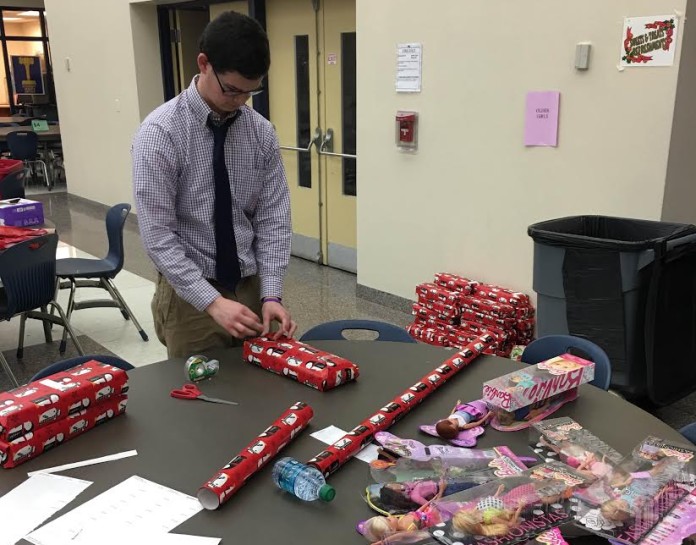
Thanks to a very generous alumnus donation, the annual toy drive run by our Student Senate has been renamed to the Shirish Patel Christmas Toy Drive. Mr. Rakesh “Rocky” Patel was a graduate of St. Ignatius of the Class of 1996 and has taken the initiative of donating $2,000 annually to our toy drive for ten years. The money will be used to cover the expenses of buying Santa suits, gift wrapping, and photos. This charitable gift takes a burden off the Student Senate and allows members participating in the toy drive to better experience the joy of giving to those who need it.

Mr. Patel’s father, Shirish, always supported service during Rocky’s time at St. Ignatius, especially the toy drive. After receiving a heart transplant, Shirish Patel even greater exemplified the spirit of the Prayer for Generosity. He truly knew what it meant “To Give and not to Count the Cost.” He lived to help others achieve their goals. He was a great man, and his son has done a wonderful job of honoring him through this gift to the school. Mr. Kelley, an organizer of the toy drive and Student Senate Moderator, informed me that, “He came to us with this donation.” When speaking of the gift, he expressed that the donation was, “incredibly kind of him.”

This year’s toy drive will take place on December 18th. The Student Senate will go to grade schools around the area to visit kids from Pre-K to Second grade to make sure most still believe in Santa. They will be given gifts and will be able to enjoy drinks as they open them. The toys will be collected from homerooms starting December 9th, and they will go to over 800 school children. Each homeroom is assigned a boy or girl and an age group to buy for. Any toys that are left over from the drive will be given to orphanages or charities. The drive, along with other Christmas events, will be displayed on banners throughout the campus this year.

Both Shirish and Rocky Patel personify what it means to be “Men for Others.” They provide a great example of something that we as students strive for. Their lasting impact on the toy drive is truly appreciated.

AP v. International Baccalaureate

by Justin Adler ‘18

While St. Ignatius and many other schools in the United States have implemented the AP program, the International Baccalaureate, or IB program, has recently emerged as competition to the Advanced Placement program. The two programs each allow students from around the world to earn college credits and display their intellectual abilities through rigorous curricula. Along with this, the students involved in each program are required to take year-end examinations that assess their knowledge from the courses throughout the school year. One major distinction between the two programs is the fact that the AP curriculum was designed for American students, while the IB curriculum was designed for International students.

Longtime AP United States History teacher Mr. Mark Pecot ‘91 compares Advanced Placement courses and the IB program as a freeway versus a train. “In the AP program, students can get on the freeway any time. If they’re ready for a challenge as freshman or sophomores, we have courses they can take. But if they aren’t ready to take on college work until their junior or sophomore year, they can hop in then.” In other words, the AP program gives a student the flexibility to choose an AP course based on his strengths. The student can opt to take an individual course at any time in their academic career. In the IB program, however, once a student chooses to participate, he must take all of the required courses in order to gain his IB diploma. “It’s like a train,” says Pecot. “If you don’t get on board your freshman year, you can’t participate in the program. The train has left the station and you’re not on it.” Because of AP’s greater flexibility, about 70% of St. Ignatius students take at least one AP course before they graduate.

Another contrast between AP and IB lies in their curriculums and examinations. AP students have the ability to choose their advanced courses, and are assessed on their competency at the end of each school year. On the other hand, IB students take a series of classes with the intent of gaining their IB diploma. To do this, they must follow a comprehensive curriculum that entails year end testing as well as a thesis incorporating all that they have learned throughout their four years.

The AP and IB programs each offer schools the opportunity to expose their students to challenging course loads while also giving them the ability to earn college credits. As the two programs have different curriculum plans, they share a common goal that involves training students to succeed on college campuses. Because of this, both the AP and IB programs are acknowledged for enriching the intellectual abilities of students from around the world.

New school year brings significant curriculum changes

by Collin Kelly ‘17

This year, big changes were made to the school’s curriculum. The changes affect a wide variety of subjects and every grade in the school.

One big change occurred in the physical education department. For physical education class, one semester accounts for one quarter of a credit, while, in all other courses, one semester accounts for half of a credit. Principal Bradesca, Vice Principal Gavin, and the curriculum board changed the structure of the physical education curriculum in order to meet state requirements. “In order to get half of a credit, the state minimum, you have to complete two semesters. So to satisfy the state requirements, we brought it back to freshman year and kept it at sophmore year,” Mr. Gavin said. But don’t worry, those who have already endured a semester of physical education with Mr. Michals won’t have to take physical education again. According to Mr. Gavin, “It is just going to affect sophomores and juniors. We are still weighing different options. Every kid is not going to have to take another P.E. class.”

Another change to the curriculum involves the fine arts department. Oral Interpretation will now be a junior course. Although the class was a freshman year staple, this change was made with the intent to make the course more comfortable and enjoyable for students. They will be more comfortable speaking in front of classmates who they have gotten to know over two years here.

Also, next year Environmental Science will be coming to Ignatius next year. The course will be available as fourth year option to seniors who would like to take a fourth year of science.

St. Ignatius has also been approved to begin an AP Capstone program, a major achievement for the school. The school was only one of eight schools in the state to be approved this year. The administration is looking into beginning this program in the upcoming school year. “The idea behind AP Capstone is two courses: One year of AP Seminar and one year of AP Research. It is a cross-curricular, collaborative course that can be paired with other AP courses. You do group work and you have to present and defend ideas,” Mr. Gavin noted.

Many of these changes will be implemented into the curriculum in the next few years. Keep an eye out for them while filling out your course request sheets this fall.

Technology use sparks issues among students and teachers

by Kevin Deegan ‘16 and Phil Massouh ‘16

Ignatius’ technology policies have become increasingly ambiguous over the past few years. At the beginning of the 2014 school year, Principal Bradesca made it a requirement to bring a laptop computer or tablet to school. The idea was to promote the usage of technology in the classroom.

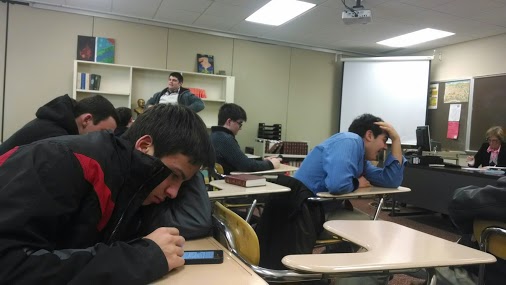
However, computer games and other distractions hindered this policy. During our present school year, “Unplugged Wednesdays” have become the new infamous initiative. These days are more a suggestion than an enforced policy. The idea is to have teachers and students shut off their computers for the day and focus more on human interaction.

Also, different teachers enforce technology usage contrastingly. With varying policies all throughout Ignatius, the goal of the administration can be a bit hazy. Because of this, the administration should standardize policies schoolwide.

A standardized technology policy is the best way to make sure that students can get the best out of their education.

A standardized technology policy is the best way to make sure that students can get the best out of their education. In some classes, teachers are oblivious to what students are doing on their laptops. Other teachers just do not allow the usage of technology in their class at all.

The main reason for this is because of the negative thing students do on their computers, whether that be playing computer games, messaging, or cheating on assignments. But these differing policies are flat out annoying. We should be able to use our required computers in every class. The administration made us buy these, and it is not fair for us to only use them in half of our classes.

Another area of contradicting attitudes towards technology has to deal with cell phones.

The administration has switched its position on this issue almost every year. Currently, students are allowed to use cell phones, but not in class or in certain areas of the school. Also, students are not allowed to access the BYOT Wi-Fi on their personal cell phone. With Principal Bradesca’s movement towards a more college-like campus, one would think that students can use their cell phones freely.

The administration needs to make a set decision on its views towards technology in the coming months. A standardized technology policy would bring unity amongst different classes and teachers, but also allow students to use their technology for effective learning.

Ignatius to offer renewable scholarships for top test takers

by Tommy Napoli ‘17

Recently, the Admissions Department has announced that a renewable merit based scholarship will take effect for the incoming class of 2020. Previously, the merit based scholarship was a fixed amount of money taken off of the cost of tuition just for freshman year. This scholarship was awarded to students who received a 93% or higher on the entrance exam. Students who scored from a 93% to a 96% on the exam received $1000 off of their tuition that year, and students who scored a 97% or higher received $3000 off.

The new program will award students who score from 93% to 96% $2000 off tuition every year until graduation. Those who score a 97% or higher on the exam will receive $5000 off annually. In order to maintain these scholarships, students must have a GPA of 3.5 or higher throughout their academic career here, and they must be in good disciplinary standing.

Much of the funding for this initiative came from private donors. The school had been looking into the program for a while, but now there are enough resources to get things moving. It is important to note that none of this money will be taken from financial aid opportunities or other departments.

This policy is not retroactive, which may be upsetting to those who received the original scholarship. Mr. O’Rourke, Admissions Director, stated that it was hard enough to get the funding to start next year, let alone for previous classes. He mentioned that people were bothered when the original program came out, but that there’s a first year for everything.

When asked about the goal of the scholarship, Mr. O’Rourke had this to say: “We want to be known as the top academic school in Ohio.” Saint Ignatius wants to make the most appealing offer possible to applicants in order to encourage a more competitive field to apply. A benefit of a more selective class would be a possible increase in test scores. The school would be more likely to continue getting large numbers of National Merit Scholars, and our average test scores on other exams may also rise.

Thanks to generous alumni and the Admissions Department, Saint Ignatius can continue to be one of the top academic schools in the state by providing better opportunities for future wildcats.

Prioritizing sleep over homework: lazy or beneficial?

by Jack Seeley ‘16

Though some may not recognize it, high school students are, on occasion, an exceptionally laborious demographic. Leaving out my peers that begin their homework before 8 o’clock (if you even exist; I have yet to find you), I’ll describe what I believe to be the two most common types of Ignatius students:

The first begins his work much too late, knowing full well how long he’ll be up. This student works into the night swigging coffee like he didn’t know he could, hoping for another bit of precious energy. But this student eventually hits the wall of exhaustion and acknowledges the headache he’s brought onto himself. He throws in the towel, knowing the next morning will be an even greater headache: but at least he will get some sleep.

The second student demonstrates similar procrastination, beginning his work even though the sun’s been set for hours. Working with a similar caffeinated beverage, telling himself to push through, this student finds the energy to finish every last assignment (bravo, my friend). But one must ask, has this student achieved such a feat by sacrificing his learning the next day?

Saint Ignatius is certainly committed to helping its students reach their full potential, but in trying to promote maximum productivity, it may be failing to recognize the reality that plagues its students. Homework, very simply, can at times be given at an almost unmanageable pace. That being said, I wouldn’t suggest the school abandon homework altogether; even the laziest of us see its significance. But is it possible that in giving out so great a deal of homework that the student population fails to experience the greatest possible amount of learning? I believe so.

For those who haven’t experienced sleep deprivation, refer to the experts: the National Sleep Foundation argues that a lack of sleep can “limit your ability to learn, listen, concentrate and solve problems.” Overall, a student’s cognitive performance is critically damaged when he or she fails to get a healthy amount of rest, which for our age group is about 8-9 hours.

While it is certainly true that students, teenagers especially, push off their homework just to add on to their free time, a policy that merely scolds students for failing to do their work may not be the best approach. I’d like to make an appeal: don’t just penalize students who come into class empty handed, but work to help them become more disciplined. Saint Ignatius is a preparatory school, after all, and it would fail to achieve its mission if it didn’t acknowledge that some Wildcats don’t continue on with the skills they’ll need.

In trying to promote a healthier and more capable high school, Saint Ignatius could implement a less punitive and more constructive type of policy to foster an even greater level of intellectual, athletic, and social growth. Perhaps a new “wellness initiative” exists that only waits to be realized.

Campus Dining denies departure from health initiative

by Joe Rosalina ‘17 and Owen Miklos ‘16

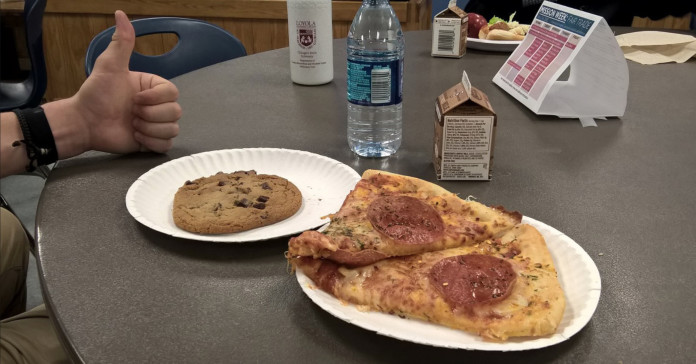
If there were a pantheon of high school cafeterias, the Rade Dining Hall would have ascended into that esteemed group long ago. It is unlikely that many other schools nationwide have such a diverse assemblage of food items; the buffets of inedible slop gracing the trays of thousands of students nationwide are nowhere to be found at Saint Ignatius, where hot meals, iced coffees, and fresh pastries are par for the course.

The addition of a salad bar in 2013 fulfilled the demand for a healthy option in a cafeteria where the proportion of healthy foods to junk was — and still remains — hopelessly lopsided in favor of the latter.

On an average morning, your average Ignatian has his choice of donuts, breakfast sandwiches, and toaster pancakes to satisfy a morning hunger pang. Come third period he has the new options of soft pretzels and gooey cookies to add to his pallette, and the day’s first pizzas — all three types — have been set out for early consumption. When our friend reaches the counter, he’s hit with sensory overload as he tries to process all of the chocolate bars, chips, pastries, and candy that sit, over flowing, from the aluminum buckets that they’ve been corralled into. Unable to help himself, Joe Fabeetz ‘18 grabs a Reese’s and a bag of Mesquite BBQ Dirty Chips before checking out and heading to his next class.

It doesn’t take a genius to figure out the disconnect here, but the question is: Is it all just a product of today’s day and age, or is there an intelligence beneath it all, driving the health initiative on a slightly more circuitous route, but on a road to wellness nonetheless?
More of the latter, so it seems:

“We’re trying to do an even balance because we are trying to give you boys a choice,” said Mrs. Marianna Burgess of Campus Dining. “We want to create an environment where no one is telling you what to eat, and where you can come up and get some great food.”

While the salad bar continues to make waves across campus, it would seem that many students are looking for options elsewhere. Seniors nostalgic for the days of fruit nuggets and Brookside chocolate-covered berries point to those and other items from Rade’s past that have dropped off the racks. Overall, though, sentiment for the present condition of the cafeteria is high.

When asked about his opinion of the recent cafeteria changes, Mike Vallee ‘16 gave his seal of approval: “Sushi is bomb.”

Court is in session: The new-and-improved Pre-Law Society provides opportunities for future litigators

by Owen Hearns ’17

The Pre-Law Society has been revived at St. Ignatius after previously failing to launch from the early stages a few years ago. Founders Brian Sabath and Michael Chime, along with moderators Mr. Howard and Mr. Sullivan have been working hard to prepare a number of opportunities for students to gather information about the law field. The founders drew their ideology for the club from the Pre-Med Society where Ignatius students can pursue an interest in the medical track before college. The club is modeled similarly and features St. Ignatius alumni who are now lawyers to share their knowledge, advice, and life experiences about the profession with members of the society. Also, the group seeks to discuss current cases and legal issues on the local, state, and national levels and present ideas for internships.

Even if you are not interested in pursuing a career in law, the society promises to motivate members to become better thinkers. According to Michael Chime, “Members have an opportunity that very few other high schoolers have. Students get to share their passion for the legal system as well as become critical thinkers.” Also, all of the founders displayed their deep gratitude for the work the moderators have done to build the club up from a student idea into a potentially successful new organization. “Mr. Howard and Mr. Sullivan were a big part of making this happen,” said Brian Sabath. “If it wasn’t for their time, I don’t think we would’ve been able to start the Pre-Law Society.” The club’s membership has grown exponentially and is predicting to continue growing for the remainder of the year.

Student Senate overhaul builds on successes of prior years

by Colin Allen ’18

Many students are unaware of what the Student Senate does at this school. On the surface, it may seem like Student Senate just consists of a group of students that are elected into office as a status position or to bolster a college resume, only sitting at the tables adjacent to the student lounge selling shirts or sending out survey emails. If you were to actually attend a meeting, you would see all of the hard work and attentive service this club offers to the school.

Student senate is a service organization that works arduously on the planning and execution of many school and community events. These elected student officials and appointed cabinet members recently organized the all school wiffleball tournament. They also brought about Food Truck Mondays this year. This effort to improve the lives of students has so far brought an area favorite, Barrio Tacos, to the school, and more trucks are coming.

Though it is only early in the year, the Student Senate has already been very busy. They planned and perfectly executed the St. Ignatius Homecoming. The Cats-Away Bay theme was a major success due to the creative poster campaign and the participation of students, opening the opportunity for divergent tropical apparel. According to Sophomore Class President Chris Larsen, “Homecoming was a great success, with the biggest turnout we have had in years.”  

With the year still being only halfway through the first semester, we can expect a lot more great things out of student senate this year. Chris Larsen says, “The year has been productive so far, but we have much more to come.” The Senate has also recently been busy planning the Arrupe Halloween Party. The Student Senate has done a great job planning and executing events, collecting school feedback, and keeping students informed. At this point, there is no reason not to believe that they will continue this good work for the rest of the year.